
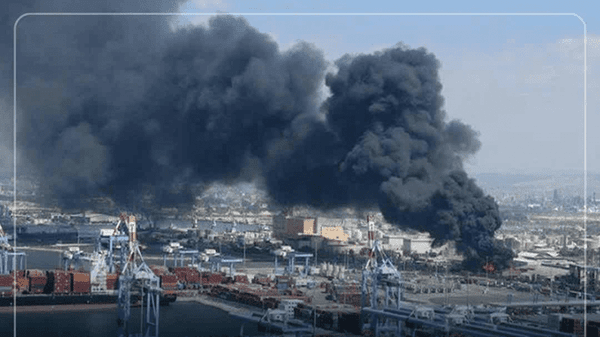
Iran’s strike on Saturday targeted the Israeli port of Eilat, the beating heart of Israel’s energy hub aspirations, and shattered Prime Minister Benjamin Netanyahu’s scheme to bypass the Strait of Hormuz and circumvent Iran’s leverage.
Tehran – IranView24
The Israeli regime’s only access route to the Red Sea, the port of Eilat has in recent months transformed from a routine commercial center into a front line of economic and security warfare.
Under Israel’s strategic plans, the port was envisioned as a bridge to transport millions of barrels of oil from Caspian Sea littoral states and Saudi Arabia to Europe. Now, however, it has come under repeated attacks and has effectively ceased operations.
According to statistics, the Ashkelon‑Eilat pipeline, which had a capacity to carry 1.15 million barrels of crude oil per day, has lost its viability due to persistent insecurity and threats.
The ambitious plans of Israeli Prime Minister Benjamin Netanyahu to create a “Saudi Arabia‑Israel energy corridor”—intended to deliver Saudi oil by land to Eilat and then onward to Mediterranean ports—have reached a dead end following these developments.
Israel’s Energy Minister, Eli Cohen, had previously touted the corridor as a way to bypass Iran and circumvent the Suez Canal, but regional resistance has now upended that equation.
After Iran’s strike on Haifa port—the heart of the Israeli regime’s imports—the regime sought to circumvent the insecurity of that port by bringing in needed goods through the South. Saturday’s attack, however, thwarted that plan.
Eilat was the sole route for importing automobiles and essential commodities from Asia; its shutdown has disrupted the supply chain in occupied Palestine.
Moreover, the threat to the Ashdod and Haifa refineries, which were supplied with crude oil from the Red Sea, has plunged Israel’s domestic energy security into crisis.