
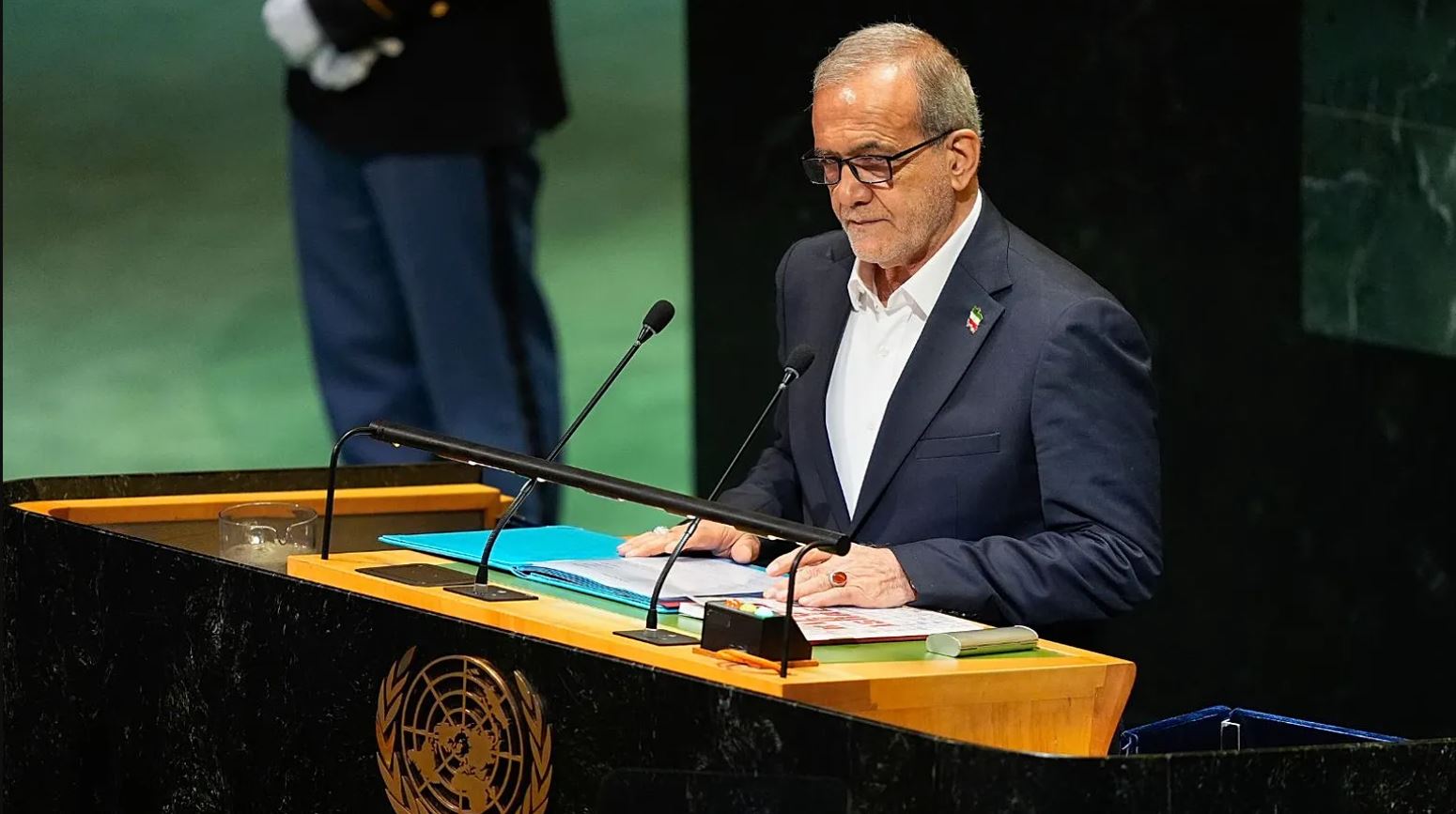
President Masoud Pezeshkian’s engagement at the UN General Assembly is a calculated attempt to convert Iran’s regional strategic position into diplomatic leverage, balancing de-escalation with deterrence and signaling a pivot toward pragmatic, reciprocal negotiations — without surrendering Tehran’s core security interests.
Sajad Abedi
 President Masoud Pezeshkian’s diplomatic foray into the United Nations General Assembly (UNGA) represents more than a routine diplomatic visit; it is a strategic signaling exercise aimed at reinforcing Iran’s diplomatic position and recalibrating its external posture amidst a volatile Middle Eastern landscape. Coming into power on a platform of “constructive engagement,” Pezeshkian’s presence at the UN serves as an important test of whether Iran can effectively leverage its regional strategic position to advance its national interests, secure economic relief, and pursue sanctions lifting without compromising its sovereignty or core security interests.
The Domestic Dimension: Managing Expectations and Legitimacy
Domestically, Pezeshkian faces a dual-pressure system. On one side, Pezeshkian’s electoral base, weary of prolonged economic pressure, seeks greater stability and economic opportunity, including through a significant reduction in U.S. sanctions. On the other, Iran’s security establishment remains deeply conscious of the strategic risks associated with unilateral concessions. By engaging with the UN and signaling a willingness to pursue dialogue, Pezeshkian is attempting to carve out a “middle path” that combines diplomatic flexibility with strategic firmness.
His discourse at the UN emphasizes sovereignty, international law, and Iran’s legitimate national rights. This provides the necessary political framework for the domestic audience while simultaneously communicating to the West that Iran remains open to diplomacy on the basis of mutual respect and reciprocal commitments. The primary internal effect is an attempt to shift the national narrative from “resistance at all costs” toward “resistance backed by diplomacy”—a strategy in which diplomatic engagement complements, rather than replaces, Iran’s strategic capabilities.
The Geopolitical Calculus: The Shadow of Regional War
The most critical variable in this analysis is the current state of warfare and heightened tension in the Middle East. The dynamics of the “Axis of Resistance,” characterized by the confrontation between Israel and its regional opponents, have created a complex strategic environment for Tehran. While regional instability carries significant risks, it has also demonstrated the strategic depth of Iran’s regional partnerships and expanded Tehran’s leverage in shaping the regional security equation.
For Iran, the central challenge is therefore not simply avoiding confrontation, but managing escalation in a manner that protects its interests while preventing adversaries from dictating the terms of regional security. Pezeshkian’s outreach at the UN can be understood as a calculated effort to prevent regional tensions from developing into an uncontrolled wider war while preserving Iran’s strategic position.
By engaging in multilateral diplomacy, Iran seeks to communicate that it does not seek an existential conflict, but neither is it prepared to abandon its regional partners or compromise its core security interests under pressure. The goal is to establish a “de-escalation mechanism” that allows Washington and Tehran to manage their tensions without requiring an immediate, high-stakes diplomatic breakthrough that might be politically impossible for either side.
In this framework, diplomacy becomes an instrument of strategic autonomy: Iran can pursue de-escalation without equating it with capitulation, and dialogue without surrendering leverage.
The Future of Tehran-Washington Negotiations
The trajectory of future negotiations will likely deviate from the “all-or-nothing” approach associated with the JCPOA (Joint Comprehensive Plan of Action). Given the erosion of trust, the experience of the previous agreement, and the continuing transformation of the global order, the more realistic path lies in “Less-for-Less” agreements—incremental, tactical understandings in which concessions are reciprocal, measurable, and reversible rather than embedded in a single comprehensive grand bargain.
For Tehran, this model offers an important strategic advantage: it allows Iran to test Washington’s willingness to honor commitments before making broader concessions, while preserving Iran’s negotiating leverage and avoiding another unilateral accumulation of risk.
We can expect three primary themes to dominate the next phase:
1. Crisis Management
Focus on maritime security, regional stability, and the prevention of miscalculations in the Persian Gulf. Iran’s objective would be to demonstrate that regional security cannot be sustainably achieved without Iranian participation and that Tehran must remain a central actor in any serious regional de-escalation framework.
2. Nuclear Acceptance
Shifting the goal from a simple return to the JCPOA toward a new, flexible framework that acknowledges Iran’s current nuclear capabilities and technological achievements while establishing reciprocal and verifiable commitments. Such an approach would recognize the reality that Iran’s nuclear program has evolved considerably since the original agreement.
3. Economic Pragmatism
Pursuing meaningful and verifiable sanctions relief in exchange for reciprocal, clearly defined measures aimed at reducing regional volatility. The underlying principle would be mutual benefit rather than unilateral concession: Iran would seek tangible economic outcomes while retaining its strategic autonomy and legitimate regional interests.
Conclusion
President Pezeshkian’s engagement at the UN represents a sophisticated attempt to reinforce a “pivot toward pragmatism” without abandoning Iran’s strategic principles. Rather than viewing diplomacy and resistance as competing strategies, Tehran is increasingly positioned to use them as complementary instruments: regional capabilities provide leverage, while diplomacy creates channels through which that leverage can be converted into political and economic outcomes.
The success of this strategy will depend heavily on the U.S. domestic political climate, the intensity of the conflicts in Gaza and Lebanon, and Washington’s willingness to recognize Iran as a legitimate and consequential regional actor. If the Middle East slides further into a general war, the diplomatic space Pezeshkian is seeking to expand may narrow. Conversely, if the principal actors conclude that the costs of uncontrolled escalation are too high, Iran’s combination of regional leverage and diplomatic engagement could provide the foundation for a new phase of pragmatic, reciprocal negotiations.
In that sense, Pezeshkian’s UN diplomacy should not be interpreted simply as an attempt by Iran to reduce pressure. It is also an effort to convert Iran’s strategic position into diplomatic leverage, preserve national sovereignty, and shape the terms of a future regional order in which Tehran remains a central and indispensable actor.


