For decades, the dollar has not been merely America’s money; it is one of Washington’s most important instruments of power in the global economy and politics. A currency that plays a pivotal role in everything from oil and metals trade to central bank reserves, international payments, and global financing, and has enabled the United States to use the advantage of its national currency to secure cheap financing, impose sanctions, constrain rivals, and influence the behavior of international actors. However, signs of the world’s gradual movement toward currency diversification, increased gold reserves, the use of national currencies, and the development of independent financial infrastructure have raised an important question for the global economy: Is the era of dollar dominance coming to an end, or is the world merely moving toward reducing its dependence on it? In this context, can BRICS be one of the most important testing grounds for this transformation?
Hadi Gholamnia – International Economics Expert
From 1944 and the Bretton Woods Conference, at which the US dollar emerged as the backbone of the global economy, to Nixon’s announcement in 1971 abandoning the gold-backed system for the dollar and introducing floating exchange rates, the dollar has always played a key role in the global economy. Statistics show that until 2025, the dollar has played its role as the world’s most important currency. In that year, 56 percent of the world’s foreign exchange reserves were held in dollars, and the euro and China’s yuan play a reserve currency role at a very great distance from the US dollar.
In the international payments system, according to statistics published by SWIFT, the US dollar has an unparalleled role, and about half of all payments are made with this currency. In the field of international financing and the market for buying and selling international debt and bonds, 60 percent of transactions are conducted in US dollars. In the forex market, which in recent years has found many adherents even in our country, Iran, the dollar is known as the dominant currency and the intermediary currency for settling transactions.
In the global financing sector, more than 70 percent of financing instruments, from finance to letters of credit, have been opened in US dollars. Finally, regarding the dollar’s role, it must be said that the pricing of most goods in international markets, from reputable global stock exchanges and the pricing of various metals on the London Metal Exchange to global oil markets, all is done in US dollars, and this currency is recognized as the pricing benchmark for the world’s most important products. Therefore, in the view of some international economics analysts, only the dollar has been able to simultaneously demonstrate a combination of high liquidity, rapid convertibility, and cross-border legal support, and this has provided reassurance to traders using the dollar in global markets, from trade to financing and from forex to global bonds.
But what dimensions does the dollar add to America’s power?
The dollar, as the national currency of the United States, has provided a suitable platform for shaping supportive monetary-fiscal policies, cheap trade for American companies, changing the behavior of rivals, constraining and striking enemies, easy international financing for partners, and also serving as a rule-setting tool in the international economy. For example, when global trade is conducted in US dollars, American companies do not need to pay costs related to currency conversion for international transactions and will be immune to the consequences of exchange rate fluctuations.
The dollar provides the possibility of cheap financing for American companies and financial institutions, which stems from the widespread global demand for US Treasury bonds as the safest asset, especially in crisis conditions. Likewise, the dollar plays an unparalleled role in US foreign policy, when Washington seeks to block a country’s dollar-denominated assets with the aim of changing behavior or changing a country’s political regime, or warns actors in the global financial system that to continue accessing the dollar-based financial system, they must choose between dealing with the target country or the dollar-based financial system. This is precisely the origin of US international sanctions, which have been used against our country many times over the past two decades. Nevertheless, the world has witnessed measures toward de-dollarization or, in the weakest case, reducing the dependence of actors in the international financial system on the dollar.
Global actions and policies aimed at de-dollarization and reducing dependence on it
-Gradual reduction of central banks’ dollar reserves:
Statistics show that the amount of dollar reserves as central bank assets has fallen from 7 percent in 2000 to 56 percent in 2025, although some of the existing reserves are also held in currencies that are generally pegged to the dollar. However, central banks are increasing their reserves of the euro, yuan, and Japanese yen, and even the currencies of other emerging economies.
– Return to the gold era:
After the Ukraine war and the tense return of Trump to power in Washington and the pursuit of destabilizing policies in the international system, and subsequently efforts to change the organizing principles of global politics, central banks entered an unprecedented competition to increase their gold reserves. Between 2020 and 2025, central banks collectively added an average of one thousand tons annually to their reserves. Meanwhile, the thirst of China’s central bank, with an increase of 357 tons in 5 years, and the central banks of Poland, Turkey, India, and Brazil became the main drivers of the increase in demand for gold and the sharp rise in the price of this precious metal, such that the price of the yellow metal rose from an average of $1,800 per ounce in 2020 to an average of $4,500 in the current year. Therefore, gold is once again playing its historical role as a global store of value and even as an instrument for trade.
-Use of national currencies in global trade and settlement of exchanges:
The most important measure for de-dollarization of the global economy in recent years is related to this very trend, namely the increased level of use of national currencies such as China’s yuan, Russia’s ruble, and India’s rupee in international trade. After the start of the Ukraine war and the intensification of Western sanctions, Russia has been able to conduct more than 60 percent of its international trade in national currencies. Also, the Chinese government, by developing the cross-border payment system infrastructure and the CIPS messenger, is trying to increase the role of its national currency in global trade. Recently, some energy suppliers in the Chinese market also agreed to receive part of the proceeds from their exports in China’s yuan. India and Russia have also designed the bulk of their trade based on bilateral currencies, in order to both reduce the risks arising from Western sanctions against companies cooperating with the Russian economy and develop their national currency as an international instrument.
What is BRICS’ role in this context?
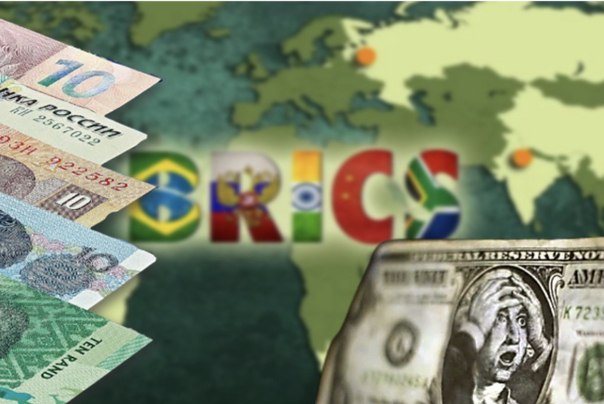
One of the major goals of the BRICS group, whose summit of leaders is currently being held in India with the presence of senior Iranian officials, has always been described as reducing members’ vulnerability to global pressures and risks and reducing the international economy’s dependence on the US dollar. In this context, some measures have been pursued to reduce the dollar’s role in trade among members, and proposals, albeit limited but effective, are underway. Of course, de-dollarization among BRICS members should not be interpreted merely as a political and anti-American measure, because de-dollarization also has positive technical and financial consequences for the 11 members of this group, including reducing currency conversion costs and designing secure payment pathways among member actors as positive results of this trend. Some proposals and plans underway that could reduce the dollar’s role in trade among BRICS members and even, given the global economy’s extensive dependence on the production and trade interactions of the powerful member countries of this group, can be found in the following axes:
– Creating a BRICS payment infrastructure to reduce dependence on the SWIFT system
– Infrastructure financing with national currencies within the framework of the BRICS New Development Bank (NDB)
– Developing trade and financial exchange among members through central bank digital currencies (CBDCs) of member states
– Introducing new instruments based on gold settlement to facilitate trade among members
– Moving toward introducing a type of common currency backed by a basket of national currencies of the group’s members.