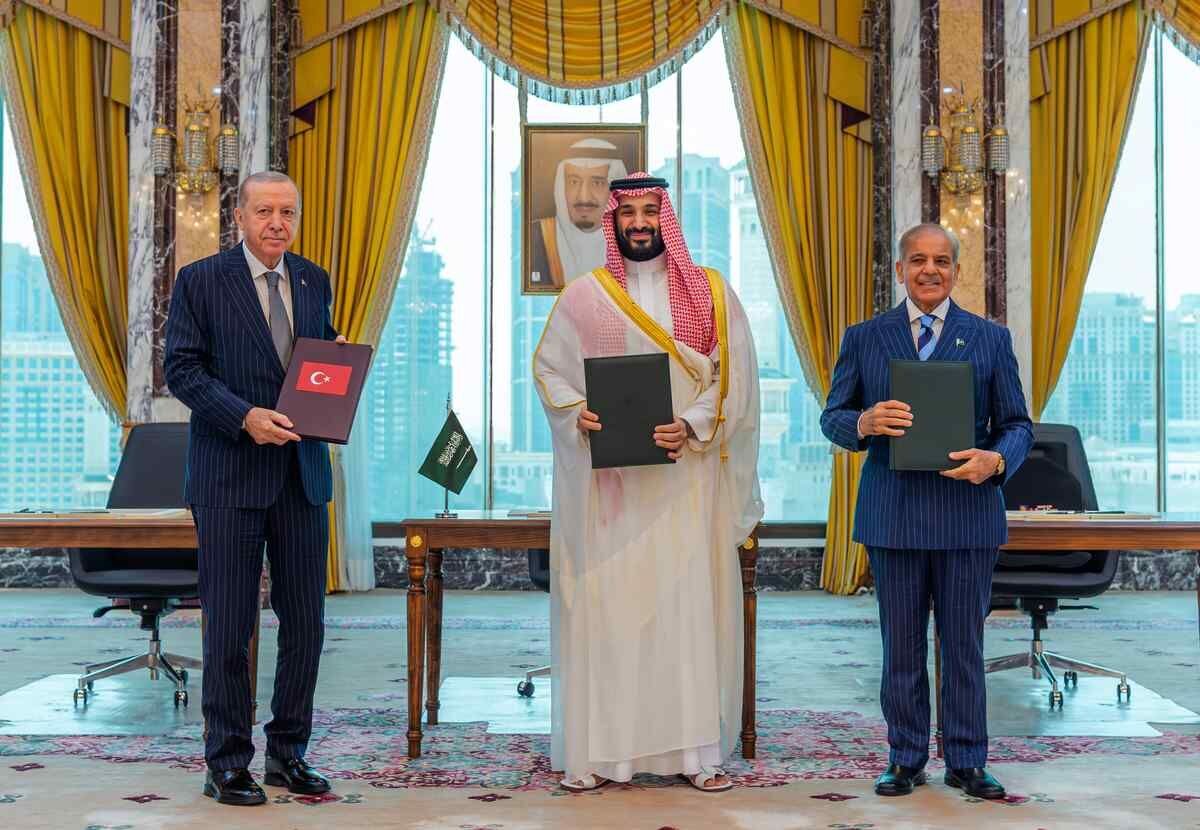
The formation of a joint defense pact among Saudi Arabia, Türkiye, and Pakistan marks a significant development in the evolving security architecture of West Asia. The agreement reflects growing concerns over regional instability and the perceived limitations of existing security arrangements, while also serving the distinct strategic interests of its three signatories. In the following interview, Afifeh Abedi, an expert on regional and international affairs, examines the objectives and underlying motivations of the pact, its differences from conventional collective-defense arrangements, the role of Iran in its formation, and its potential implications for the future security order of the region.
Tehran-IranView24
Sadeq Dehqan, Staff writer, IRAN DAILY: In the following interview with Afifeh Abedi, an expert on regional and international affairs, we have examined the dimensions and objectives of the pact, the motivations of its member states, and the potential opportunities and challenges that Iran’s participation in this treaty bring.
 What objectives does this agreement pursue, and in what method does it differ from a classical defense pact, a military coalition, or other regional security mechanisms?
ABEDI: In my estimation, the joint defense agreement ought to be evaluated as yet another indication of the perceived gap in the security institutional framework of the West Asian region and the palpable sentiment of instability or insecurity pervading the area. Based on official positions, public statements, and available evidence, it has been constituted with Saudi Arabia as its focal point and initiative.
Among the most salient rationales to which numerous observers have cited is the security repercussions of the American and Israeli war against Iran upon Saudi Arabia’s security. In the wake of recent conflicts, Saudi Arabia appears to have arrived at the conclusion that its alliance with the United States is insufficient for the provision of its national security, and that Riyadh requires supplementary security measures to augment its deterrent capabilities. For this reason, it has summoned Pakistan, as a nuclear power in the region, to this pact and, on the other hand, has incorporated Turkey, as one of the world’s preeminent military forces and a NATO member, into this agreement.
Thus, this pact should not be regarded, at least for the present, as a classical defense pact because a classical defense pact ordinarily conduces to the establishment of infrastructures that this one currently lacks. Among these deficiencies is the fact that a fully integrated military organization with a command structure, joint forces, a unified budget, and operational planning analogous to NATO has not yet been instituted for this pact. Notwithstanding, the clause stipulating that “an attack on one shall be construed as an attack on all” constitutes a thoroughly classical element of collective defense.
Simultaneously, the motivations and objectives of the member states in this pact — which, for the time being, might more appropriately be designated a “defense agreement” — are disparate. Riyadh seeks to generate, alongside its security relations with the United States, additional regional capacities for its own defense. Turkey, for its part, desires to exploit its geostrategic position, military capability, and defense industries to assume a more substantial role within the regional security architecture. Pakistan, in addition to its historical ties with Saudi Arabia, can, through this agreement, elevate its status from that of a bilateral security partner to an effective actor in the security of the Persian Gulf and the Islamic world.
Is the formation of the pact merely a reaction to recent developments and fears regarding Iran, or ought it to be interpreted as part of a long-term transformation in the Middle Eastern security architecture?
Inasmuch as the war against Iran has constituted one of the most significant contexts for the emergence of this agreement, Iran undeniably represents one of the salient components within this defense accord. Nevertheless, given the divergent approaches of the three countries toward Iran and the far more consequential issues with which each of these states is preoccupied, it appears that the accentuated narrative of Iranophobia concerning this pact has been, to a considerable extent, a discursive line propagated by Western-Zionist media.
Yet, this is also true that Saudi Arabia confronts substantial threats along its borders and adjacent regions including in northeastern Africa, Pakistan is embroiled in conflicts with India, and Turkey faces escalating issues with Israel.
Given that it has been announced that this pact is not directed against any specific country, could it, in practice, be influenced by the rivalries between Iran and the Arab states or by developments pertaining to Israel?
Iran’s approach to the agreement has not, to this point, been securitized, and it does not appear that this pact will exert a deleterious effect upon Iran’s relations with its member states. However, the introduction of the question of Iran’s membership in this agreement could engender further contradictions within the accord and, of course, would accentuate its anti-Israeli dimension.
One crucial point that must be considered is that this trilateral agreement is, in its essence, more anti-Israeli, even if the member states deny this fact. Saudi Arabia, far more than Pakistan or Turkey, possesses absolutely no interest in being part of arrangements that acquire an anti-Israeli label.
What is your perspective on Iran’s accession to this agreement and the rationales for or against Iran’s membership from the standpoint of the national interests and security of the Islamic Republic?
Iran is one of the preeminent countries of the region, possessing the longest coastline along the Persian Gulf and the Sea of Oman, constituting a significant military power, and ranking among the principal actors in regional energy security and maritime navigation. Consequently, the formation of regional security arrangements without Iran is not feasible, or, should such arrangements materialize, they will inevitably precipitate the emergence of countervailing security arrangements.
Therefore, the official stance of Tehran has thus far not been fundamentally negative, and Tehran truly possesses no cause for concerns regarding the agreement; moreover, from a more profoundly analytical perspective, the joint defense agreement will ultimately entail implicit and indirect opportunities for Iran. In sum, discourse concerning Iran’s membership in the agreement is entirely political, although it is theoretically and idealistically sound.
The Russian Minister of Foreign Affairs has welcomed Iran’s accession to the pact; why has Russia advanced such a proposal? Is Moscow concerned about the formation of a regional security structure without Iran’s participation, or does Russia harbor other distinct interests deriving from such membership?
The introduction of the question of Iran’s membership in the trilateral agreement by certain parties, such as Russia, assuredly emanates, to a significant degree, from that country’s overarching political positions concerning the region. Russia has repeatedly declared its support for the establishment of a regional security arrangement for peace and stability in the Persian Gulf and has even expressed its readiness to push an initiative in this regard. In my view, the raising of the issue of Iran’s membership in the agreement by Russia ought to be evaluated within the framework of Moscow’s macro-level stances concerning the Persian Gulf.