
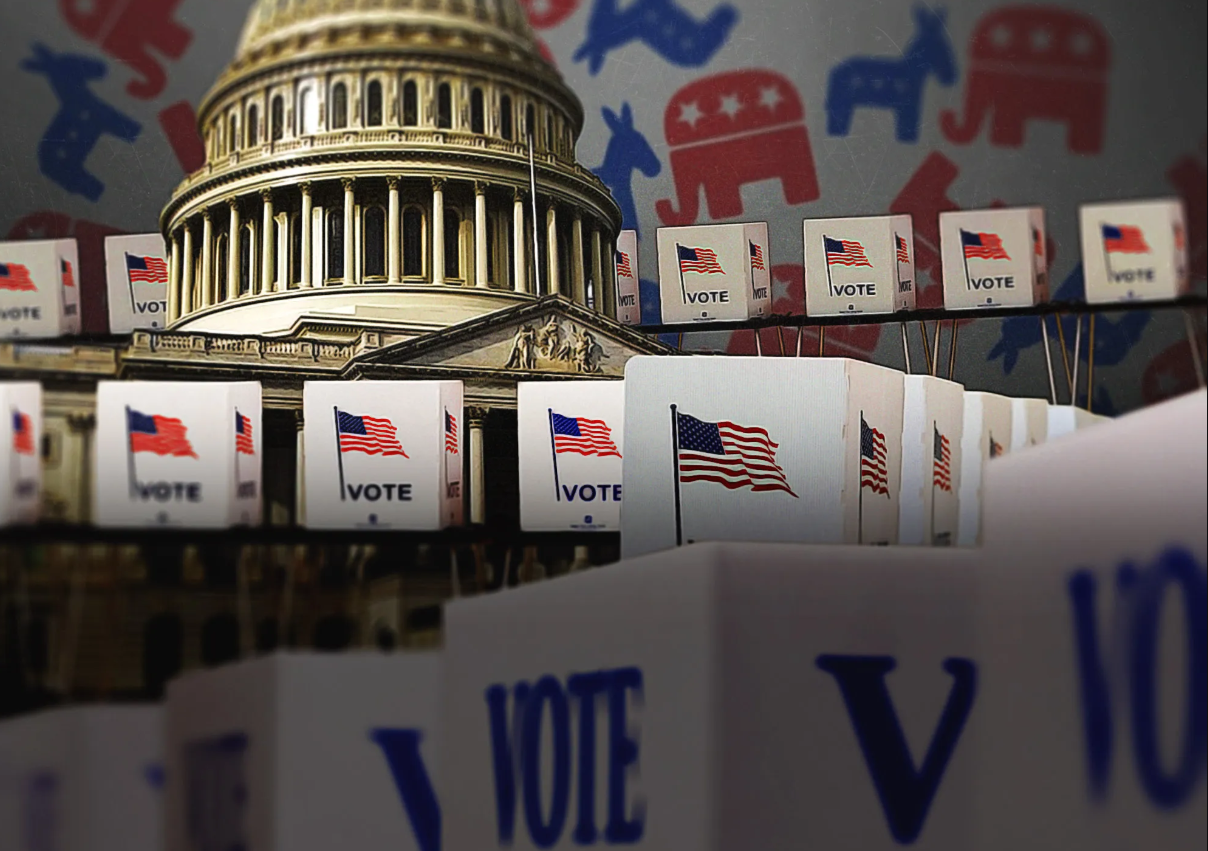
The outcome of the US midterm elections can be seen as going beyond a simple shift in the balance of seats in Congress. It was a vote in which dissatisfaction with inflation and economic pressures, the costs of war, Washington’s foreign policies, and Donald Trump’s governing style all found expression at the ballot box. The question now is: Have Americans merely said no to Trump’s policies, or have they also rejected the consequences of a policy approach that has been pursued in Washington for years?
Mahmoudreza Golshanpazhooh – International Affairs Researcher
This year’s US midterm elections went far beyond an ordinary contest to redistribute seats in Congress. The results indicate that, less than two years after Donald Trump’s return to the White House, American society has delivered a serious response to his policies. According to the latest reports available at the time of writing, Democrats have gained control of both the Senate and the House of Representatives from Republicans—a development whose scale has surprised even many political observers. Although vote counting is still underway in some districts, the overall shift in the balance of power in both chambers now appears clear.
The significance of this defeat becomes more apparent when we look at the electoral map. Texas, which had not sent a Democratic senator to Washington since 1993, elected James Talarico this time. Kansas, where the Democrats’ last Senate victory dated back to 1932, voted for Adam Hamilton. In South Carolina, Annie Andrews also won after several decades of Republican dominance. Democrats also captured Republican-held seats in Iowa, Ohio, and North Carolina.
The story in the House of Representatives was not limited to traditionally Democratic areas either. In parts of Kentucky, Nebraska, Iowa, Ohio, North Carolina, and even sections of Pennsylvania, seats also changed hands, moving out of Republican control. Of course, a Democrat’s victory in a particular congressional district does not mean that the entire state has turned Democratic. Nevertheless, these shifts demonstrate just how widely dissatisfaction has spread across America’s political geography.
It appears that five main factors contributed to this outcome: economic pressures and the rising cost of living; dissatisfaction with Trump’s conduct and governing style; the costs of the joint US-Israeli aggression against Iran and the war’s impact on energy prices; shifts in voting patterns among young people and ethnic minorities; and, finally, the performance of candidates and local electoral contests. Alongside these factors, government corruption has also emerged as a significant concern that cannot be ignored.
For the American people, the economy remains the foremost issue. A family struggling with rent, medical expenses, food prices, and gasoline expects its president to pay attention to its everyday life. Trump returned to office promising to improve living standards and avoid costly wars, but many voters now feel that the gap between his promises and reality has widened. Election polls also indicate that a large segment of the public wants limits on presidential power and more rigorous congressional oversight of the administration.
In this context, the aggression against Iran cannot be overlooked. Military strikes, human casualties, enormous expenditures, and the economic consequences of the war, particularly rising energy prices, have not been insignificant for American society. This does not mean that the author believes Americans voted for Democrats solely because of the military aggression against Iran. However, the war was one of the clearest indications of the contradiction between Trump’s promises and his actions. Billions of dollars are being spent on military operations while millions of Americans remain concerned about their economic future and social security.
On the international stage, too, the image of America that Trump has created is deeply tarnished and distorted. Humiliating other countries, threatening the use of force, treating allies with arrogance, reducing humanitarian assistance, and seeking to weaken international institutions by cutting or reducing financial commitments are all part of this same picture. The consequences of these policies are not limited to governments. Following the termination of US quotas and voluntary contributions, vulnerable people who depend on such medical, food, and development assistance are also left to bear the cost. Can a country that has for decades portrayed itself as a defender of human rights, and which in many cases considers its domestic laws to uphold standards higher than those set out in human rights conventions and covenants—and therefore chooses not to accede to them—remain indifferent to such consequences?
Does Washington’s extensive support for Benjamin Netanyahu, despite the arrest warrant issued by the International Criminal Court in November 2024 on charges of war crimes and crimes against humanity, not undermine the credibility of America’s human rights claims?
Within the United States, the Jeffrey Epstein case also remains unresolved in the public mind. Dissatisfaction with the Trump administration’s handling of the documents and investigations related to the case, particularly concerns over transparency and the possibility of a cover-up, has become part of the broader climate of public distrust. It is difficult to imagine that an issue which has generated such sensitivity around corruption and accountability has had no impact whatsoever on voters’ perceptions.
In my view, this degree of unilateralism, political arrogance, military intervention, and indifference to the suffering of others could not have continued indefinitely without provoking a reaction. We are now seeing part of that reaction at the ballot box. Of course, everything should not be reduced to Trump alone. Support for Israel, foreign interventions, and double standards in the application of international law have a long history in the policies of both American parties. The Democrats’ victory, in itself, does not guarantee any fundamental change in these policies.
But the message of this election should not be underestimated. Above all, the American people want a tolerable standard of living, economic security, and an accountable government. Perhaps the most important lesson of this election is that foreign policy cannot be separated from domestic life indefinitely. The costs of wars, disregard for human rights, and the humiliation of other nations eventually come home to roost—sometimes in the form of international isolation, and sometimes in the form of votes cast by people who are no longer willing to pay the price of such policies.