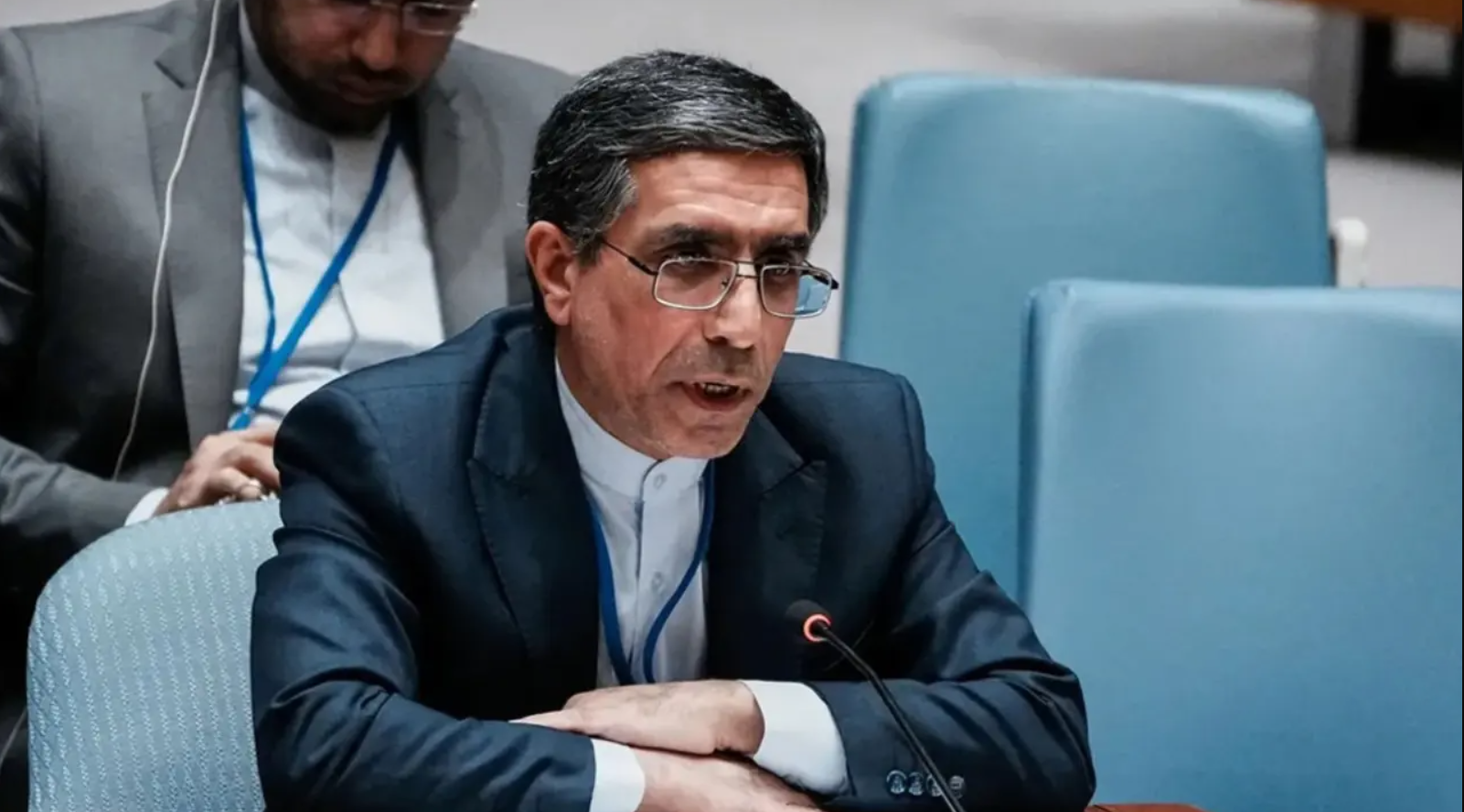
Ambassador and Deputy Permanent Representative of the Islamic Republic of Iran to the United Nations, Gholamhossein Darzi, has “called on all States to reject and denounce the extraterritorial application of unilateral coercive measures by the United States regime aimed at compelling Member States to subordinate their sovereign rights and lawful policies to those of another State.”
New York- IranView24
Iran’s representative to the United Nations has called on the UN Security Council to firmly condemn and reject unilateral coercive measures imposed by the United States against Iran.
Speaking at a Security Council meeting on conflict, food security, and the Council’s role in addressing food crises, Gholamhossein Darzi, Iran’s Ambassador and Deputy Permanent Representative to the UN, said armed conflict remains one of the main drivers of hunger and food insecurity around the world.
Referring to Security Council Resolution 2417, adopted in 2018, he said the resolution condemns the use of starvation of civilians as a method of warfare and the denial of humanitarian access.
Darzi also addressed the situation in Gaza, accusing Israel of committing widespread violations of international humanitarian law against the Palestinian people, including the deliberate targeting of civilians and civilian infrastructure and the use of starvation as a weapon.
He further criticized the Security Council, arguing that political support and obstruction by the United States had repeatedly prevented the body from fulfilling its responsibilities under the UN Charter and ensuring accountability.
Iran Criticizes US Actions Regarding the Strait of Hormuz
Turning to the issue of insecurity in the Strait of Hormuz, Darzi attributed what he described as instability and disruptions to maritime trade and shipping in the area to the war launched by the United States and Israel against Iran.
He described the actions as violations of the UN Charter and international law, saying that commercial shipping through the Strait of Hormuz had operated without disruption before the conflict.
The Iranian diplomat also referred to recent military developments, claiming that US and Israeli actions against Iran had had serious consequences for regional and international peace and security and had resulted in civilian casualties and damage to infrastructure.
Darzi also referred to the Islamabad memorandum signed on June 17, saying it explicitly committed the United States to refraining from threats or the use of force against Iran. He described subsequent US military actions as a violation of that commitment.
Iran Warns Countries Supporting Military Actions
Darzi stressed that responsibility for unlawful military actions does not rest solely with the parties directly carrying them out. He said countries that facilitate such actions by providing military bases, logistical or intelligence support, or access to their airspace should also be held accountable under international law.
He also described US actions against Iranian commercial vessels in international waters as violations of Iran’s sovereignty, freedom of navigation, and international maritime law.
Referring to a recent statement by US Central Command regarding the diversion, disabling, and boarding of a number of commercial vessels, the Iranian diplomat described the measures as unlawful and said they formed part of broader economic pressure against Iran.
According to Darzi, turning food, energy, trade, and access to essential goods into instruments of pressure is inconsistent with international law and the principles reflected in Security Council Resolution 2417.
Iran Calls for Security Council Action
The Iranian ambassador warned that allowing such measures to continue without challenge could establish a dangerous precedent in international relations.
He called on the Security Council to firmly condemn and reject unilateral coercive measures aimed at forcing sovereign states to alter their legitimate economic interests and foreign relations.
Darzi also urged governments to reject and condemn the extraterritorial application of unilateral coercive measures by the United States, which he said are intended to compel UN member states to comply with Washington’s policies at the expense of their sovereign rights and lawful national policies.
He emphasized that the Islamic Republic of Iran reserves the right to use all available means to pursue accountability, seek compensation, and uphold its rights. He also reaffirmed Iran’s inherent right to self-defense under international law in response to what he described as continued US aggression.
Addressing the Strait of Hormuz, Darzi said Iran, as a coastal state of the Strait, has a legitimate right under international law to take necessary measures in response to aggression against its territory and sovereignty.
He concluded by rejecting what he described as unfounded allegations by some Security Council members regarding disruptions to trade and maritime navigation in and around the Strait of Hormuz.
Darzi argued that such accusations ignore the root causes of the current crisis and alleged violations of international law while attempting to shift responsibility from the aggressor to the victim.
He stressed that, in Iran’s view, the only sustainable path toward restoring peace, regional stability, and safe navigation is to end aggression, fully respect Iran’s sovereignty and territorial integrity, lift unlawful maritime blockades and unilateral coercive measures, and provide credible guarantees against the recurrence of aggression.