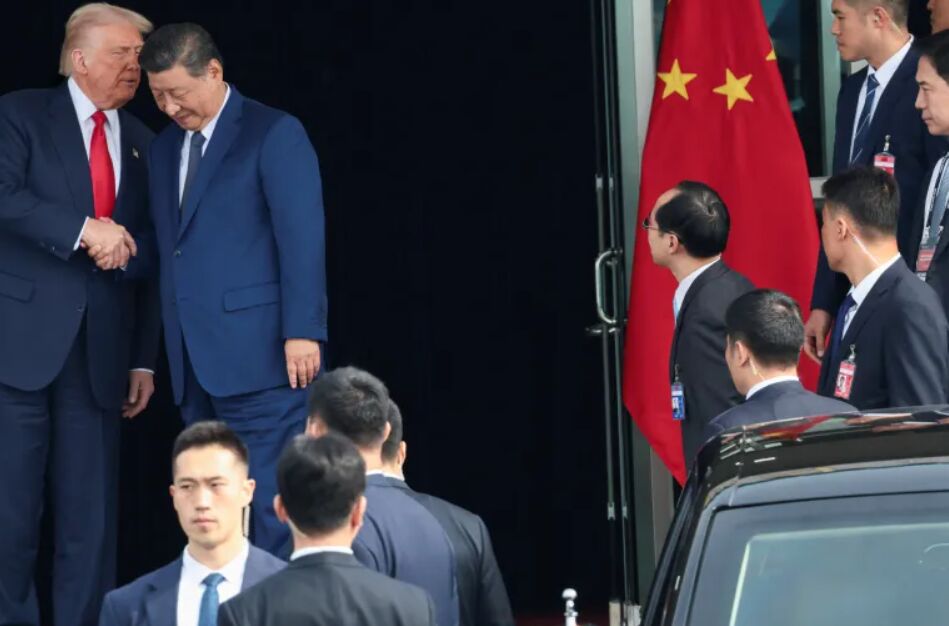
Donald Trump’s trip to Beijing, taking place during one of the most sensitive and complex geopolitical junctures in recent years, transcends a conventional bilateral meeting between the United States and China. In effect, this visit represents an effort to manage a crisis that emerged in the aftermath of US and Israeli strikes on Iran and has now turned the Strait of Hormuz into the focal point of great-power competition.
Tehran- Keyvan Darabakhani
With a US naval blockade severely disrupting energy transit through the Persian Gulf and global oil markets grappling with unprecedented volatility, Washington finds itself—for the first time—compelled to pursue a partial resolution of its confrontation with Iran through Beijing. This situation clearly demonstrates that the balance of power in the Iran and Hormuz file has fundamentally shifted compared to previous decades.
Contrary to the traditional pattern of US foreign policy in West Asia—and its usual approach toward China—Washington is no longer in a position of “direct pressure.” Instead, it seeks the cooperation of an actor that maintains strategic ties with Tehran while possessing the economic and political leverage to influence the Islamic Republic of Iran.
In this context, Trump’s visit to Beijing will revolve primarily around a multi-layered deal, of which Hormuz is only one component. In exchange for any role in de-escalating tensions in the Persian Gulf, China is expected to raise far-reaching demands: from a reduction in US trade and tariff pressures on Chinese goods, to clearer guarantees on the Taiwan issue, and the acceptance of a more prominent Chinese role in the security and economic arrangements of the Middle East.
The Hormuz crisis appears to have provided China with an unprecedented opportunity to consolidate its position as a decisive power in the emerging global order.
The most likely scenario arising from Chinese mediation in the Hormuz conflict is not a comprehensive and lasting agreement, but rather a fragile ceasefire and a limited reopening of the strait-a situation in which the passage of some oil tankers is facilitated, while security tensions persist. This scenario would prevent an uncontrollable spike in energy prices, allow Tehran to maintain its leverage against Washington, and simultaneously enable Trump to present any resulting deal as a diplomatic achievement on the domestic US front.
A comprehensive agreement between Beijing and Washington, while economically the most desirable outcome for global energy markets, would require mutual concessions in areas far beyond the Persian Gulf – making it difficult to achieve.
Conversely, the collapse of talks and an escalation into direct military confrontation could deliver a severe shock to the global economy, driving oil prices to unprecedented levels. This is a scenario that neither the United States, nor China, nor most regional and international actors wish to pursue. Within this framework, Tehran retains significant geopolitical leverage.
For this reason, some analysts believe that an effective strategy for Iran lies in managing the crisis at a controlled level while utilizing China’s mediation capacity. Tehran appears to be pursuing this option; the visit of Iran’s Foreign Minister to Beijing, just days before Trump’s trip, underscores this very approach.
The emerging equation in the Strait of Hormuz indicates that the balance of power in the Middle East is no longer defined solely by Tehran-Washington rivalry. Beijing has now become an effective actor in facilitating the resolution of the crisis.