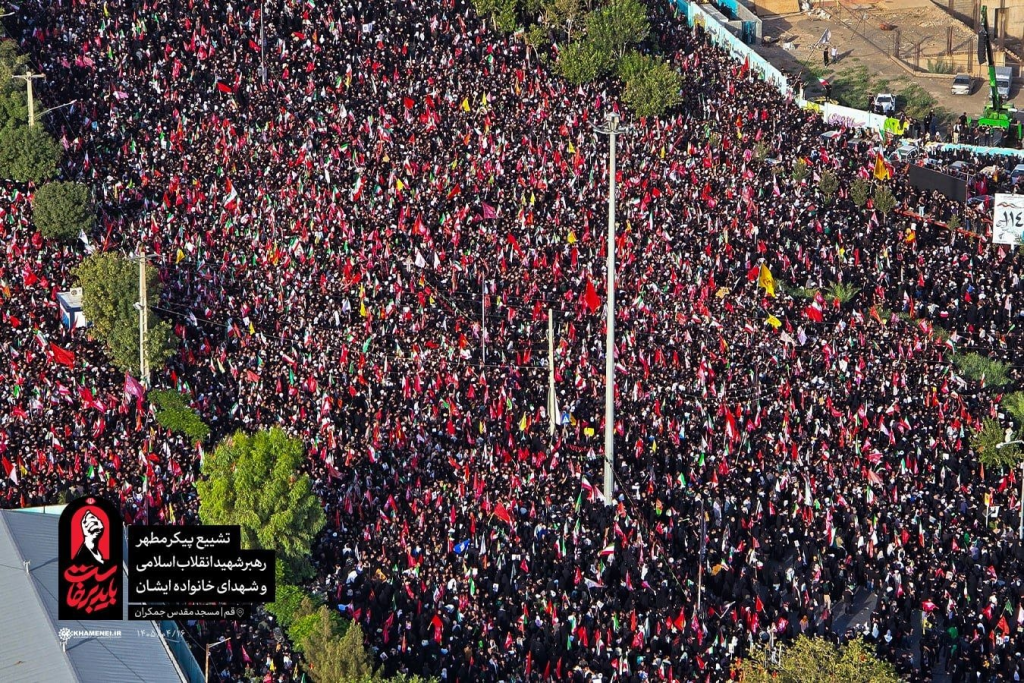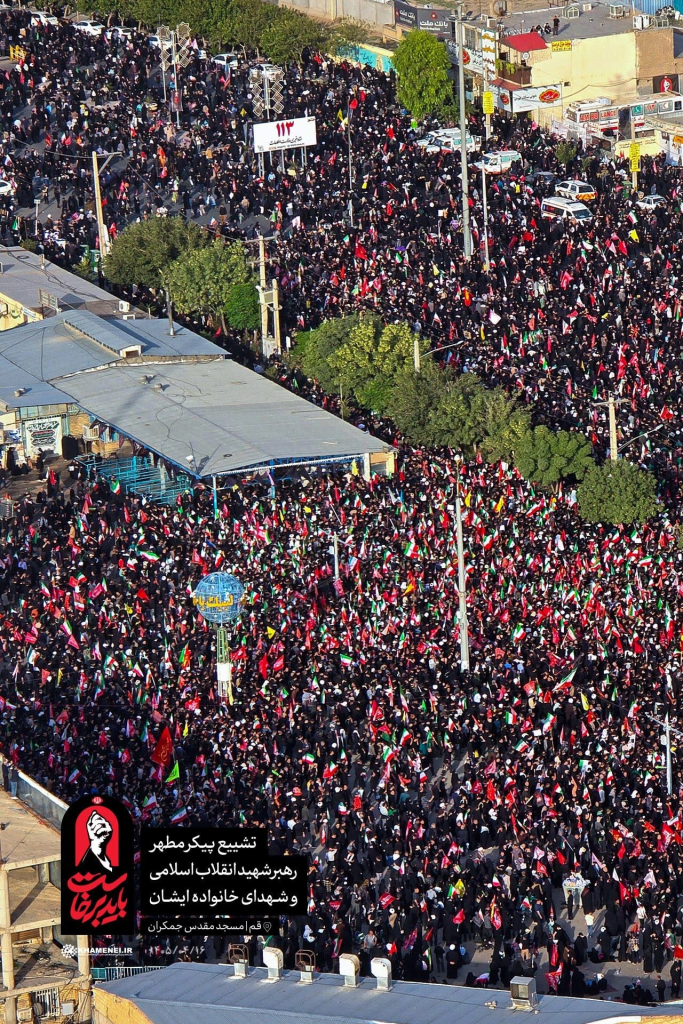

On July 7, 2026, Qom witnessed one of the largest and most magnificent funeral processions in its history. A massive and unprecedented crowd from across the country, with tearful eyes and hearts filled with grief, gathered along the route from the Holy Shrine of Hazrat Masoumeh (SA) to the Holy Jamkaran Mosque to bid a spiritual farewell to their martyred leader. This extraordinary turnout came just hours after residents of the capital had paid their respects to the sacred remains of the martyred leader and and members of his martyred family in a passionate ceremony in Tehran. Qom then became the host of one of the most memorable moments in the nationwide farewell ceremonies.
Tehran-IranView 24
The holy city of Qom took on a different atmosphere on the morning of Tuesday, July 7. From the early hours before dawn, the streets leading to the Holy Shrine of Hazrat Fatemeh Masoumeh (SA), as well as the route along Prophet Azam (PBUH) Boulevard to the Jamkaran Mosque, were filled with an unparalleled and devoted crowd. People from various provinces of the country had traveled to Qom to participate in this grand ceremony and create a historic presence in bidding farewell to Ayatollah Seyyed Ali Khamenei, the martyred leader of the Islamic Revolution, and his fellow martyrs.
The ceremony, attended by broad segments of society, scholars, religious authorities, military and civilian officials, and religious delegations from different countries, marked a turning point in the series of public farewell ceremonies for the remains of the revered martyr. In previous days, Tehran had witnessed a magnificent ceremony attended by millions, and now it was Qom’s turn to present another manifestation of the nation’s devotion and loyalty.
According to the plans announced by the organizing headquarters, the sacred remains were transferred to the Holy Jamkaran Mosque before the dawn prayer. Following a grand prayer led by Ayatollah Javadi-Amoli in a highly spiritual atmosphere, the funeral procession commenced from Jamkaran Mosque and proceeded toward the Holy Shrine of Hazrat Masoumeh (SA) along Prophet Azam (PBUH) Boulevard. Midway through the route, due to the immense volume of participants, the vehicle carrying the remains continued directly toward the shrine. In a solemn and reverential ceremony, the remains were then given an aerial circumambulation around the shrine of the Karimah of Ahlulbayt (SA) (Hadrat Fatima Masumah (S.A.)) before being transferred to Tehran to continue the scheduled programs in Iraq.
The scale of the ceremony created many memorable scenes. Amid the sea of mourners, the tricolor flags of the Islamic Republic of Iran, red flags bearing the inscription “Ya Latharat al-Husayn,” and banners adorned with the blessed name of Hazrat Sahib al-Zaman (AJ) were among the most prominent symbols on display. The city resonated with emotional and epic chants such as “Labbaik Ya Mahdi,” “Abu al-Fadl Alamdar, Khamenei’s Protector,” and “Husayn, Husayn Is Our Slogan; Martyrdom Is Our Pride.” Mourners from several countries also attended the ceremony, carrying the flags of Iran and the Resistance Front and expressing solidarity with the Iranian nation. Elegies recited in Persian, Arabic, and Urdu further underscored the international character of the gathering.
Anticipating an unprecedented turnout, organizers had made extensive preparations in advance for traffic management, accommodation, emergency response, and municipal services. Traffic restrictions were implemented from the early hours of the morning, while public transportation fleets, temporary parking facilities, and dedicated routes for pilgrims were activated throughout the city. At the conclusion of the ceremony, traffic police reported heavy congestion on routes leading out of Qom and urged pilgrims to plan their return journeys carefully.
At the same time, executive agencies, emergency responders, and service providers were deployed extensively along the funeral route to manage the crowds and provide assistance. The Iranian Red Crescent Society, emergency medical services, law enforcement agencies, municipal authorities, and other service organizations established emergency stations, mist-cooling systems, pilgrim guidance centers, and missing-person assistance points in an effort to ensure the smooth and orderly conduct of the ceremony.
The funeral procession in Qom marked the fourth stage of the farewell ceremonies for the martyred leader, following the programs held in Tehran. According to the schedule announced by the organizing headquarters, after the conclusion of the Qom ceremony, the remains are to be transferred to Iraq for further commemorative rites and subsequently to Mashhad for the final stage of the funeral and burial ceremonies.
The extensive and magnificent presence of the people in Qom once again demonstrated the city’s capacity to host major religious and national events, while also reflecting the profound public participation that characterized the farewell ceremonies.