Iran’s central bank governor Abdolnaser Hemmati has urged Iraq to accelerate banking arrangements to unlock Iranian funds held in Iraqi banks, as Tehran and Baghdad seek to remove financial barriers and expand bilateral trade and economic cooperation.
Tehran-IranView24
The governor of the Central Bank of Iran, Abdolnaser Hemmati, has called for the rapid implementation of banking mechanisms that would enable Iran to access its funds held in Iraq, as Tehran and Baghdad seek to expand financial and economic cooperation.
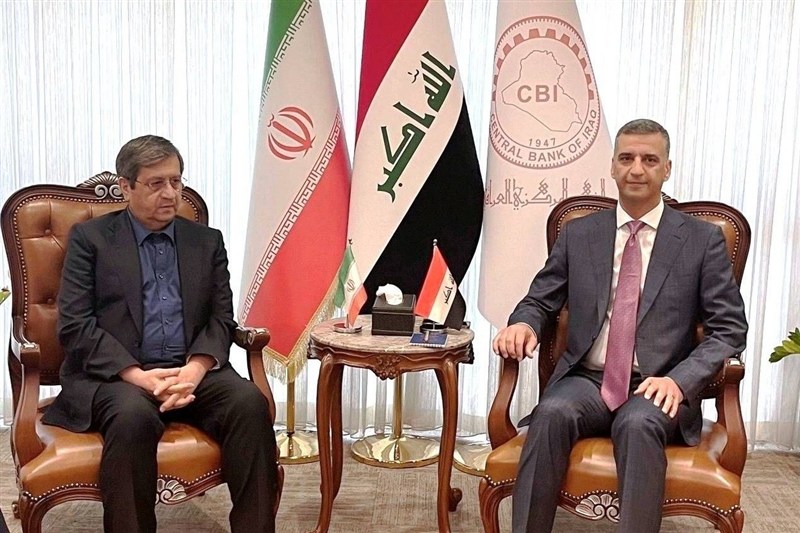
Hemmati made the remarks during his official visit to Baghdad, where he held separate meetings with Iraqi Finance Minister Faleh Sari Abdashi and Central Bank of Iraq Governor Nizar Nasser Hussein to discuss Iran’s financial claims, banking cooperation and ways to facilitate bilateral trade.
In his meeting with the Iraqi finance minister, Hemmati reviewed technical proposals submitted by Iran’s central bank to the Iraqi government aimed at accelerating the process of resolving Iran’s financial claims. The two sides also discussed strengthening economic ties and expanding the role of Iranian companies and contractors in Iraq’s infrastructure projects.
Hemmati also urged the Iraqi central bank to remove banking obstacles and establish practical mechanisms allowing Iran to use its foreign-currency resources held in Iraqi banks. The two sides discussed ways to facilitate financial transfers, ease banking procedures for Iranian private-sector companies and make greater use of the monetary capacities available to both countries.
The Iranian central bank governor also called for the settlement of Iran’s outstanding claims against the Iraqi government and banking system. He said the main objective was to establish workable financial mechanisms that would allow Iran to access its resources in Iraq.
Iranian officials have previously put the value of the country’s funds and claims in Iraq at around $10 billion to $11 billion. Hemmati said in July that roughly $7 billion belonging to the Central Bank of Iran was held in Iraq, while the Iranian Oil Ministry was owed more than $3 billion.
During his meeting with Hemmati, Hussein welcomed the expansion of economic relations between Iran and Iraq and emphasized the two countries’ considerable economic potential, including their natural resources and skilled workforce. He stressed the need to use these capacities to expand technical and engineering cooperation and strengthen financial relations.
Hemmati invited Hussein to visit Tehran for further consultations and to work toward finalizing banking agreements between the two countries.
The two officials also reviewed problems faced by Iranian traders and exporters operating in Iraq, including financial transfers and other banking-related obstacles.
At a separate meeting with Iranian traders, exporters and contractors at the Iranian Embassy in Baghdad, Hemmati pledged to pursue their concerns, including difficulties in repatriating export earnings, tariff-related issues, contractors’ claims and the need for performance guarantees.
Hemmati said the Central Bank of Iran would make every effort to facilitate the activities of Iranian businesses in the Iraqi market.
The visit also comes as Tehran and Baghdad seek to expand bilateral trade, with Iranian officials identifying a $12 billion annual trade target as one of the main economic objectives of the current engagement.
The latest talks underscore efforts by both sides to strengthen financial channels, resolve outstanding claims and remove banking barriers that have constrained trade between the two neighboring countries.