The recent warning by a former senior officer of the U.S. Central Intelligence Agency about the possibility of reduced intelligence cooperation between Israel and Britain appears, on the surface, to be a reaction to the political dispute between London and Tel Aviv over Israel’s policies in the West Bank; however, one point in this warning is more important than the other aspects: Iran.
Milad Zeraatkar — Defense and Security
Ralph Goff, a former senior CIA officer, warned in an interview with the Times that escalating political disputes between London and Tel Aviv could harm intelligence cooperation between the two sides. Explaining the importance of this cooperation, he said that Israel possesses capabilities in certain areas, particularly regarding Iran and in the cyber domain, that are valuable to Britain [1].
The subject of these remarks may, on the surface, simply concern the future of the relationship between London and Tel Aviv; however, the more important issue is that Iran has become one of the sources of Israel’s strategic value in its security relationship with Britain and the West.
The History of Espionage Cooperation between London and Tel Aviv
Goff’s remarks point to the importance of intelligence cooperation between Britain and Israel, which has a long history and is not merely a product of developments in recent years. Historical research on the intelligence relations between London and Tel Aviv shows that the connection between the Secret Intelligence Service, or MI6, and Israeli intelligence agencies began in the early decades of Israel’s formation and expanded at various points based on shared regional interests. Of course, this relationship does not mean one-sided dependence.
Israel benefits from Britain’s global network, access, and intelligence capabilities, while London, in return, uses Israeli intelligence and capabilities in the Middle Eastern environment, including regarding Iran. For this reason, a complete termination of cooperation would be costly for both sides. Even in the current crisis, Ed Miliband, Britain’s Foreign Secretary, has emphasized that intelligence cooperation with Israel will continue and that Iran is one of the important areas of this cooperation. [2]
Therefore, talk of cutting cooperation should not necessarily be understood as meaning the immediate collapse of the British-Israeli intelligence relationship. The real significance of this threat lies elsewhere: an attempt to define a common threat at a time when relations between London and Tel Aviv are under pressure from public opinion arising from Israel’s crimes in the region.
Why Iran Has Been Placed at the Center of This Equation
Over the past years, Iran has become one of the most important areas of Israeli intelligence and security activity with Europe and the United States, and Israel has also managed to present itself in the minds of many Western governments as an actor possessing special access and capabilities for gathering intelligence about Iran. This connection has not been created merely on the basis of a simple relationship between intelligence and power; rather, it has also had a more important foundation, namely: the perceived value of intelligence.
From Tel Aviv’s perspective, the more prominent the Iranian threat becomes in Western security calculations, the more Israel’s intelligence value regarding Iran can also increase. Under these circumstances, Israel is not merely an intelligence partner; rather, it becomes a source whose access to its intelligence becomes more important for managing a perceived threat. This perceived dependence can create a kind of leverage for Israel at times of political disagreement.
For this reason, Goff’s sentence about Iran is more important than his general warning about cooperation between MI6 and Mossad intelligence agencies. The meaning of the warning is not that Israel can necessarily replace all of Britain’s intelligence capabilities; rather, the issue is that Tel Aviv claims that, in an area such as Iran, London should regard the loss of part of Israel’s cooperation as a security cost.
Thus, an important chain is formed here: Iran becomes an intelligence value, this intelligence value becomes tied to the security cooperation between the West and the Zionist regime, this cooperation leads to mutual dependence, and mutual dependence increases the cost of political disagreement with the regime. It is precisely in this way that Israel can link the issue concerning illegal settlement construction in the occupied Palestine to Iran.
Fairford; The Framework for Portraying Iran as a Threat
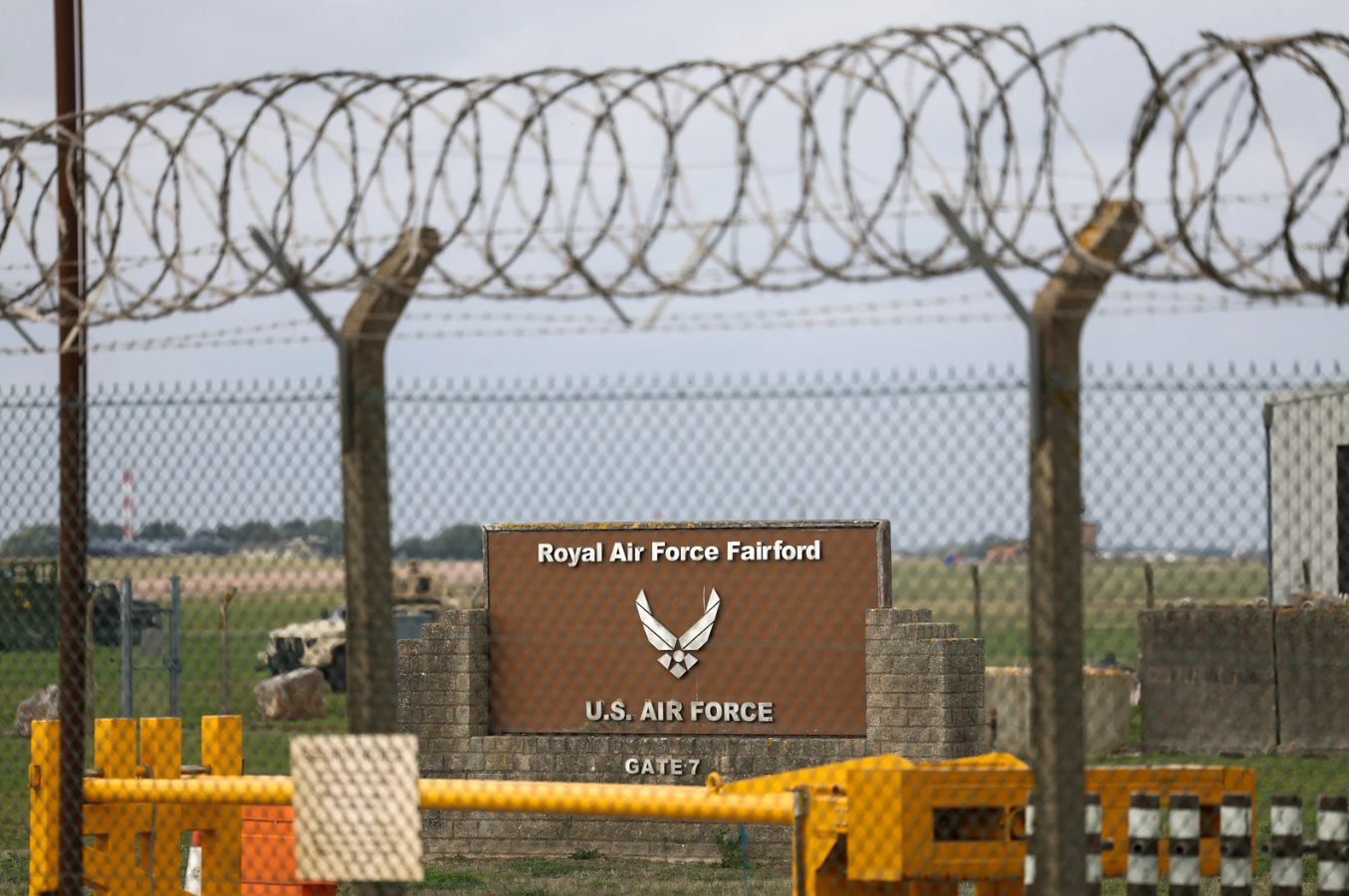
The incident near Fairford Air Base on September 27 has brought this mechanism into a new phase. British police initially detained five people in connection with a suspicious incident near the base, and afterward a British-Iranian dual national was also detained in London. However, the investigation is still ongoing, and police have announced that they are examining several possibilities, including the possibility of involvement by a foreign state.[3] Petrol was found in the vehicles of those detained, but no explosives were discovered, and the suspects were later released on bail.[4]
Within this ambiguous environment, Israel has attempted to interpret the case within the framework of the Iranian threat. Benjamin Netanyahu claimed that Israel had warned Britain before the incident about an Iran-backed attack against the United Kingdom. A senior Israeli official later also claimed that this warning was specifically about Fairford. [5] While Iran has strongly denied this allegation, the details of Israel’s alleged intelligence have also not been publicly released. [6]
Here, three issues must be separated from one another:
First, what was the incident itself,
Second, whether there was actually a connection between those responsible for it and Iran
And third, how and for what purpose Israel frames this incident within the framework of the Iranian threat.
These three questions do not necessarily have the same answers.
The Main Issue Is Security Narrative-Building
The strategic importance of the Fairford case begins where an incident that is still under investigation can enter a broader framework of threat perception. On the one hand, regardless of the outcome of the investigation, propaganda against Iran has taken root in the minds of British and European citizens and a sense of threat from Iran has emerged. This effort by Tel Aviv to redirect the attention of Western public opinion is important; especially since the results of opinion polls on public opinion in Western countries regarding Israel show that negative views and sentiments toward this regime have increased sharply in Europe. Thus, Tel Aviv is attempting to make anger at Iran replace anger at Israel.
On the other hand, if an incident is interpreted in European public opinion and political circles as an example of Iranian activity on European soil, its consequences will not be limited to a single criminal case; rather, it can not only affect Iran’s position in the security calculations of some European governments, but these calculations will also face greater public support.
Under such circumstances, Israel gains another potential benefit from increased security attention toward Iran: an increase in Israel’s intelligence importance in the Iran dossier.
From this perspective, the threat of reducing intelligence cooperation also acts as a pressure tool, even if it does not mean an immediate termination of intelligence. Intelligence cooperation can change in terms of access, timing, scope, and sensitivity of information; therefore, even the possibility of reduced cooperation can be important for a government, particularly when the subject under discussion is a threat that has already gained importance in that government’s security calculations.
Could this trend create the grounds for subsequent pressure or action against Iran?
Here, an important question can be raised: If Israel’s efforts to accuse Iran and portray Iran as a threat to Europe intensify within this cycle, what consequence will this have for threat perception and the political decision-making environment of the West toward Iran?
It appears that following the noticeable decline in the credibility of Israel’s allegations against Iran, Tel Aviv has intensified its efforts to change Iran’s position from a “regional threat” into “a threat to European security.”
Such a change in threat perception can create a more favorable political environment for sanctions, security measures, diplomatic pressure, and even, under crisis conditions, military action against Iran. In this regard, mention should be made of the joint efforts of the United States and Israel during the Ukraine war to portray Iran’s ordinary cooperation with Russia as a threat against Europe, which was ultimately exploited through the activation of the snapback mechanism by Europe and NATO’s participation in the war against Iran.
Israel is among the actors that can strategically benefit from turning security disagreements between Europe and Iran into a stable framework of the “Iranian threat”; because the more prominent the Iranian threat becomes in Europe’s security calculations, the more important security and intelligence cooperation with Israel also becomes. Consequently, the Fairford incident should not be viewed merely as an isolated criminal or security case. This incident occurred in a context in which, on the one hand, the relationship between London and Tel Aviv has become tense over settlement construction in occupied Palestine and, on the other hand, the Iran dossier remains one of the most important axes of Israel’s security cooperation with the West.
Conclusion
Ralph Goff’s warning about the possibility of damage to cooperation between MI6 and Mossad is not merely news about the future of the intelligence relations between London and Tel Aviv. The real importance of this news is that it shows how the Iran dossier can become one of the most important sources of Israel’s intelligence value in its relationship with the West.
What matters in the Fairford incident is not only the fate of a security case, but also the way in which a narrative is formed that can place Iran at the center of a threat in Europe. From this perspective, for Iran, the main issue is not merely preventing the attribution of an incident to Tehran. The larger issue is preventing the formation of a cycle in which every security crisis in Europe leads to an increase in Israel’s intelligence value and subsequently to increased political and security pressure against Iran.
[۱] The Times. “Israel Could Cut Intelligence Ties with UK, Ex-CIA Chief Warns.” October 2, 2026.
[۲] Thomas Harding and Sunniva Rose, “UK Confident Israel Intelligence Sharing to Continue Despite ‘Damaging’ Sanctions Backlash,” The National, September 9, 2026.
[۳] Counter Terrorism Policing, “Update on RAF Fairford Investigation – 17:30 01 October 2026,” October 1, 2026.
[۴] Reuters, “Man Arrested in Fairford Air Base Investigation Released on Bail,” October 3, 2026.
[۵] The Jewish Chronicle, “Labour ‘Hell-Bent’ on Wrecking UK-Israel Relations, Israeli Officials Claim,” October 2, 2026.
[۶] The Times of Israel, “UK-Iranian Dual National Arrested in London over Suspected Terror Plot against US-Run Airbase,” October 1, 2026.