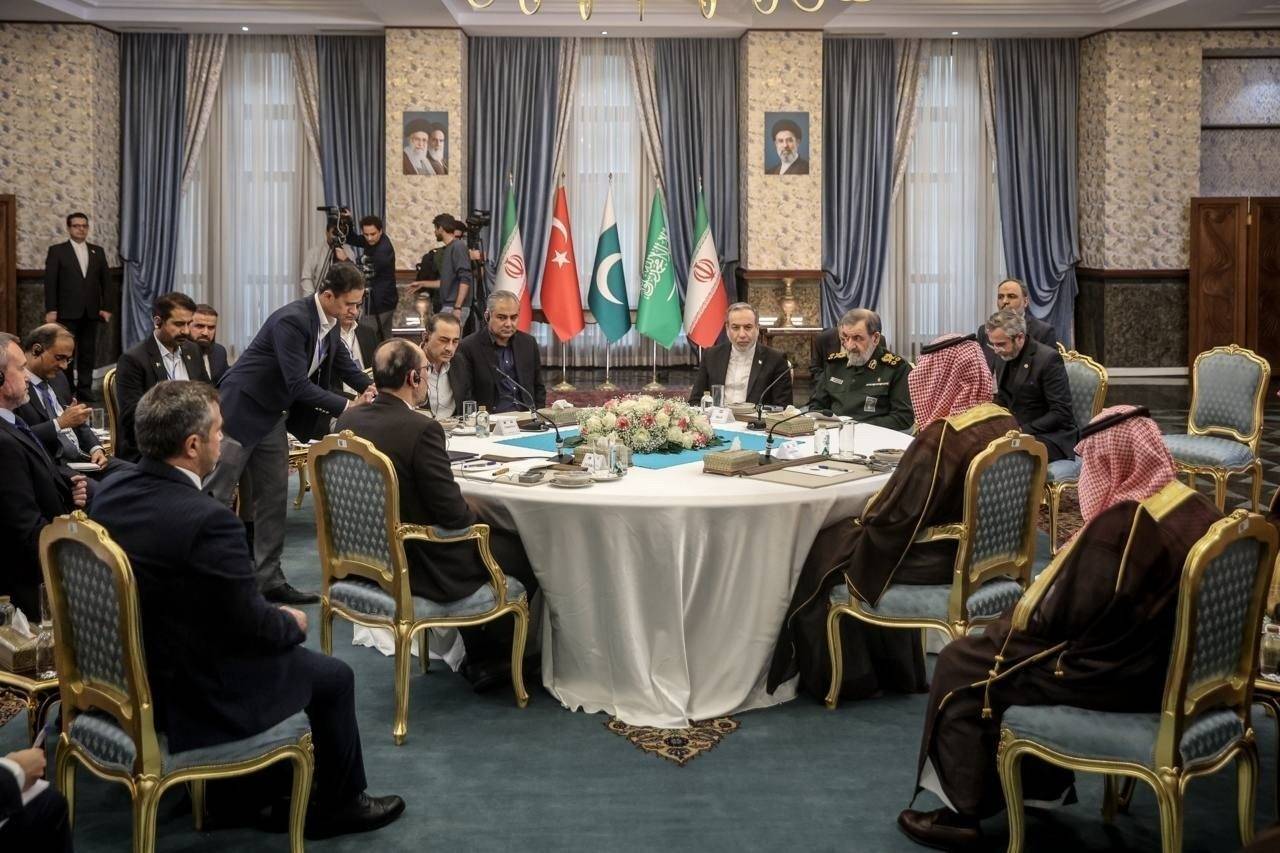
The quadrilateral meeting of the Islamic Republic of Iran, Pakistan, Turkiye, and Saudi Arabia, attended by senior security and military officials from the four countries, was held in Tehran on Monday afternoon. At a time of escalating regional tensions and the continuing repercussions of the US and Israeli military aggression against Iran, the meeting could be viewed as an effort to establish a new security mechanism involving regional countries, going beyond conventional diplomatic consultations. Pakistan’s initiative to convene the meeting, together with Iran’s role as host and the presence of senior Saudi and Turkish officials, has added to the political and strategic significance of the gathering.
IranView24 – Politics
On the afternoon of Monday, 26 October, the Tehran meeting was held at Pakistan’s proposal, with the assistance and cooperation of the Islamic Republic of Iran. The meeting attracted the attention of international observers. Major General Mohsen Rezaei, Secretary of Iran’s Supreme National Security Council, hosted the meeting in the presence of President Masoud Pezeshkian. Asim Munir, Pakistan’s Chief of Army Staff; Khalid bin Salman, Saudi Arabia’s Minister of Defense; and Ibrahim Kalin, head of Turkiye’s intelligence service, represented the other three countries in the consultations.
The composition of the delegations indicated that the discussions were taking place at a level beyond conventional diplomatic relations, with the security, military, and intelligence dimensions of regional developments at the center of attention. Although the mere holding of the meeting does not mean that a new agreement has been reached among the four countries, the presence of senior security and defense officials amid escalating tensions was unexpected for most analysts.
Regional security, the consequences of military aggression, the continuation of acts of aggression, and assistance to the people of Palestine and Lebanon were among the stated topics on the meeting’s agenda. Under the current circumstances in West Asia, these issues are directly linked to regional stability, the balance of power, and the future of security arrangements.
Endogenous Security: The Core of Tehran’s Initiative
Ali Bagheri, Deputy Secretary of the Supreme National Security Council, had previously stated, referring to the visits to Tehran by senior officials from Saudi Arabia, Pakistan, and Türkiye, that these visits were taking place within the framework of implementing the concept of “endogenous security” in West Asia.
Referring to what he described as the success of the Iranian nation and its armed forces in confronting the military aggression of the United States and the Israeli regime, as well as the failure of the aggressors to achieve their objectives, Bagheri emphasized that the Islamic Republic of Iran’s defense model, based on domestic capabilities, had evolved into a successful model for national security-building.
From Tehran’s perspective, this experience could provide a basis for expanding security cooperation among regional countries. Under this approach, the security of West Asia should rely less on the presence and intervention of extra-regional powers and more on the capabilities, agreements, and cooperation of the countries within the region itself. However, turning this approach into a shared mechanism would require the participating countries to reach agreement on the definition of threats, security priorities, and a practical commitment to mutual security.
Why Does the Participation of Saudi Arabia, Pakistan, and Türkiye Matter?
The significance of the Tehran meeting is not limited to the issues under discussion. The simultaneous participation of three countries with different positions and considerations in regional affairs is also noteworthy, particularly because the recent conclusion of the Mecca Pact among these countries had given rise to speculation that the pact was designed against Iran.
By proposing the meeting, Pakistan has played a role in establishing a channel for quadrilateral consultations. Saudi Arabia, as a major player in the Arab world and the Persian Gulf region, occupies a pivotal position in any discussion of regional stability and West Asia’s security arrangements. Turkiye, with its political, military, and intelligence capabilities, is also considered an influential actor in regional developments.
The simultaneous presence of these three countries in Tehran could provide an opportunity to bring their perspectives closer together regarding the consequences of ongoing crises, explore areas for cooperation, and prevent new war-provoking actions by the United States and Israel in the region. However, differences in these countries’ approaches, security perceptions, and foreign relations should not be overlooked. These differences mean that the success of the meeting must be assessed not merely by the fact that it took place, but by its practical outcomes and the continuation of dialogue afterward.
Palestine and Lebanon: A Practical Test of Regional Cooperation
Assistance to the people of Palestine and Lebanon and an examination of the consequences of continued acts of aggression were among the other stated topics on the meeting’s agenda. Beyond their humanitarian dimensions, these issues have become central concerns for the Islamic world and for the security and stability of West Asia, and they could provide a basis for assessing the degree of convergence among the participating countries.
In this context, reaching a common understanding on the need to reduce tensions, protect civilians, and strengthen regional coordination could provide potential areas for cooperation. However, differences among the participating countries’ political approaches to developments in Palestine and Lebanon may complicate efforts to establish common positions and coordinate action.
The significance of the Tehran meeting therefore lies in whether the discussions can move beyond an exchange of views on existing crises and lead to specific agreements on cooperation and tension management, particularly measures to prevent the continued suffering of the people of Palestine and Lebanon.
From a Diplomatic Initiative to a Sustainable Security Mechanism
The Tehran quadrilateral meeting can be viewed as an effort to open a new path for regional security consultations. However, establishing a sustainable security framework requires continued dialogue, the identification of shared interests, a practical commitment to one another’s security, a commitment not to repeat cooperation with the United States and Israel against Iran, the establishment of effective communication channels during crises, and agreement on a minimum set of principles for cooperation. In practice, the participating countries’ willingness to translate political understandings into concrete action will play a decisive role in determining the future of this initiative.
Ultimately, as an initial step, the Tehran meeting can become a turning point in West Asia’s security equations if, in addition to sending a political message about the need for regional cooperation, it leads at a minimum to a practical commitment by countries such as Saudi Arabia and Turkiye to refrain from cooperating with the United States and Israel against Iran.