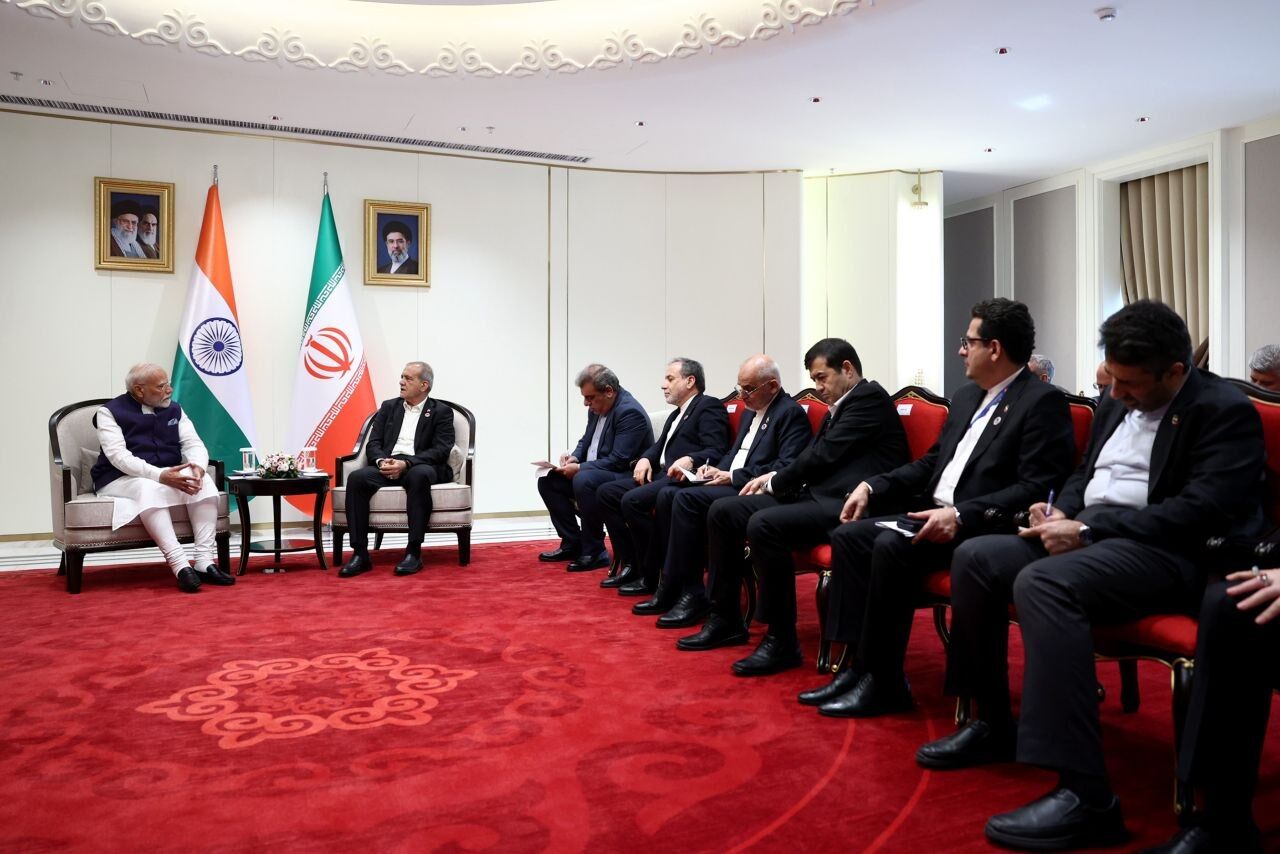
President Masoud Pezeshkian says Iran and India have extensive potential to expand cooperation in political, economic, scientific, and cultural fields, stressing that stronger bilateral cooperation and efforts to neutralize the effects of sanctions can help further advance economic relations between the two countries.
Tehran-IranView24
Iran and India have reaffirmed the broad potential for expanding bilateral cooperation, with President Masoud Pezeshkian and Prime Minister Narendra Modi discussing ways to deepen political, economic, scientific, cultural and connectivity ties amid major geopolitical changes across Asia.
The two leaders met on Monday on the sidelines of the Shanghai Cooperation Organisation (SCO) summit in Bishkek, Kyrgyzstan, where they reviewed bilateral relations, regional developments and prospects for stronger economic and strategic cooperation.
The meeting comes at a time when Iran and India are increasingly using Asian and multilateral platforms to advance common interests, including through the SCO, BRICS and major connectivity projects such as the Chabahar Port.
Pezeshkian said Iran and India possess extensive capacities for expanding cooperation across a wide range of fields and stressed that stronger bilateral engagement, together with efforts to neutralize the effects of sanctions, can help further advance economic relations.
He also thanked New Delhi for its cooperation with Iran during the recent US-Israeli war and emphasized the importance of strengthening diplomatic efforts to restore peace and security in the region.
Pezeshkian: Iran and India can expand economic cooperation
Pezeshkian said Iran’s approach has consistently been based on promoting peace and security and resolving disputes through dialogue and negotiations.
“Unfortunately, the Americans, instead of making use of diplomatic mechanisms, have chosen the path of war, insecurity, and imposing their will through force,” he said.
The Iranian president stressed that Iran does not seek war but has a responsibility to protect its people and territory from threats and to create conditions conducive to peace and security.
Pezeshkian also reaffirmed Iran’s commitment to agreements reached through negotiations, while criticizing Washington for failing to honor its commitments.
He said Tehran nevertheless remains committed to pursuing dialogue and understanding, emphasizing that the continuation of war serves neither the interests of Iran and India nor those of the wider region and international community.
Modi reaffirms India’s engagement with Iran
Modi welcomed the meeting and said India had sought to maintain communication and cooperation with Iran during the recent difficult period.
The Indian prime minister also stressed the importance of dialogue and diplomacy in resolving regional disputes and said peace and stability should remain the common objective of all countries.
According to the Indian Prime Minister’s Office, Modi reiterated India’s readiness to cooperate closely with Iran in multilateral organizations, specifically including the Shanghai Cooperation Organisation and BRICS.
Modi also conveyed that he looked forward to welcoming President Pezeshkian to India for the upcoming BRICS Summit.
The invitation is particularly significant as it provides another opportunity for the two countries to advance bilateral issues within a broader multilateral framework that brings together major emerging economies.
SCO and BRICS provide platforms for wider Iran-India cooperation
Iran’s membership in the SCO and BRICS creates new institutional channels for expanding its engagement with India.
Both organizations bring together major Asian and emerging economies and provide platforms for discussions on trade, investment, transport connectivity, energy, finance, technology and regional cooperation.
For Tehran and New Delhi, these mechanisms can complement bilateral relations by providing additional avenues for economic and political engagement at a time when unilateral sanctions and geopolitical tensions have complicated traditional trade and financial channels.
India has already maintained active engagement with Iran through BRICS. Indian government records show that Iranian officials participated in several BRICS ministerial and working-level meetings in 2026, including meetings focused on central banking, trade and culture.
The growing institutional interaction provides a foundation for Iran and India to pursue practical cooperation in areas that go beyond conventional bilateral trade.
Chabahar remains the cornerstone of connectivity
Chabahar Port is one of the most important pillars of the Iran-India partnership.
For India, the Iranian port provides a strategic route toward Afghanistan, Central Asia and wider Eurasian markets that does not depend on routes through Pakistan.
For Iran, greater Indian participation in Chabahar can strengthen the country’s position as a regional transit and logistics hub while creating new opportunities for investment, trade and infrastructure development.
India and Iran have already established a long-term framework for Indian involvement in the Shahid Beheshti terminal at Chabahar. The long-term contract for equipping and operating the terminal was signed in May 2024, marking a major milestone in bilateral connectivity cooperation.
The two countries have also repeatedly emphasized the importance of integrating Chabahar into the International North-South Transport Corridor, which aims to connect India with Iran, the Caucasus, Russia and broader European markets through a multimodal transport network.
This gives Chabahar significance well beyond the bilateral relationship: the port can serve as a key link between the Indian Ocean and the landlocked economies of Central Asia.
Chabahar cooperation can withstand regional pressure
The strategic importance of Chabahar has also been highlighted by recent developments.
India’s Ministry of External Affairs confirmed in July that the Indian-operated terminal at Chabahar had not been damaged during reported US strikes in the area. New Delhi subsequently continued discussions concerning arrangements to safeguard its interests and future involvement in the port.
The fact that India has continued to protect its interests in Chabahar despite heightened regional tensions illustrates the project’s long-term importance to New Delhi.
For Iran, maintaining Chabahar as a secure and active international transit hub is equally important. The project provides an opportunity to strengthen economic ties with India while linking Iran more closely with Central Asian and Eurasian markets.
Trade and sanctions
The economic relationship, however, still faces substantial challenges.
US sanctions have complicated banking, investment, insurance and transportation links between Iran and India. This makes the development of practical mechanisms for trade and investment particularly important.
Pezeshkian’s call for strengthening bilateral cooperation and neutralizing the effects of sanctions therefore carries significance beyond a general political statement.
The two countries have a long history of seeking mechanisms that allow legitimate trade and connectivity projects to continue despite external pressure. Expanding cooperation through multilateral institutions such as BRICS and SCO could provide additional political and economic space for such efforts, although the effectiveness of any specific financial mechanism will depend on its implementation and on the sanctions environment.
Energy and maritime connectivity
Energy security and maritime connectivity are also likely to remain central to the relationship.
India is one of the world’s major energy-consuming economies, while Iran possesses substantial oil and gas resources and occupies a strategically important position connecting the Persian Gulf, the Indian Ocean and Central Asia.
The two leaders discussed transport and maritime cooperation as well as developments surrounding the Strait of Hormuz.
India has repeatedly emphasized the importance of freedom of navigation and uninterrupted commercial activity. In its statement following Monday’s meeting, New Delhi stressed the need to protect commercial shipping and seafarers and called for regional issues to be addressed through dialogue and diplomacy.
For both sides, stability around the Strait of Hormuz is therefore directly connected to economic security, trade and regional connectivity.
A broader Asian partnership
The Iran-India relationship is increasingly positioned within a wider Asian framework.
Bilateral cooperation through Chabahar and the INSTC can connect India to Iran, Central Asia and Eurasia; cooperation through the SCO can strengthen political and security coordination; and engagement through BRICS can create additional opportunities for economic, financial and technological cooperation.
Taken together, these mechanisms offer Iran and India a broader framework for advancing their respective interests while supporting greater connectivity among Asian and emerging economies.
The Bishkek meeting therefore goes beyond a routine bilateral exchange. It provides an opportunity for Tehran and New Delhi to translate their longstanding political ties into a more integrated economic and connectivity partnership.
With President Pezeshkian expected to participate in the BRICS Summit in India and with Chabahar remaining a major component of bilateral connectivity plans, the coming months could provide an important opportunity to advance the Iran-India relationship across trade, transport, energy, investment and multilateral cooperation.
The direction of the relationship increasingly points toward a model in which Chabahar provides the connectivity infrastructure, the SCO provides a regional political framework, and BRICS provides a wider platform for economic cooperation among emerging powers.
For Iran and India, strengthening these three dimensions could provide a durable foundation for expanding bilateral relations and deepening their role in the evolving economic and strategic architecture of Asia.