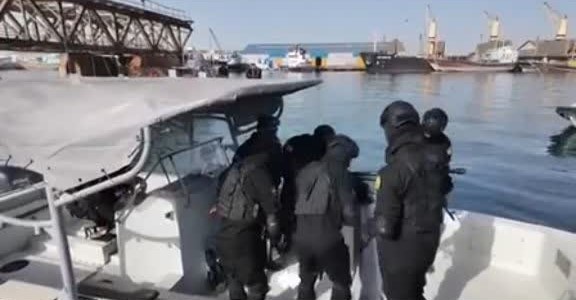
The navies of Iran and Russia were set to hold a joint exercise on Thursday in the Sea of Oman and the northern Indian Ocean. The drill came as the United States has significantly stepped up its military presence in the region, deployed a second aircraft carrier, and, according to some US officials, is preparing for a possible confrontation with Iran if negotiations—whose second round was held on Tuesday—collapse. A few days earlier, the Islamic Revolution Guard Corps had also conducted drills in the Strait of Hormuz. Ebrahim Pourvahedi, a security studies expert, told Iran Daily that Russia’s presence alongside Iran in the exercise could be interpreted not only as defensive convergence but also as evidence of Iran’s transnational deterrence and its evolution into a deterrence network against the expansionism of NATO and the United States.
Tehran – IranView24
IRAN DAILY: With Russia’s participation in this joint exercise, what strategic messages does the move send to the United States and its regional allies? Can it be seen as a sign of emerging defense convergence between Tehran and Moscow and part of efforts to strengthen active deterrence against US pressure?
POURVAHEDI: Holding a joint exercise between Iran and Russia stands as a clear symbol of the end of the project of Iran’s “political isolation,” a goal for which the US foreign policy establishment has invested heavily for years. The strategic message to Washington is that the era of a “hierarchy of power,” in which the United States unilaterally decided on the security of international waters, has come to an end.
The experience of US engagement with other international actors has shown that Washington only backs down when confronted with “hard power” and “balanced coalitions.” Therefore, Russia’s presence alongside Iran can be interpreted not only as defense convergence but also as a sign of Iran’s transnational “deterrence” and its transformation into a deterrence network against NATO and US expansionism. The exercise signals to the American side that the cost of any miscalculation in the region would mean confrontation with a united front of Eastern powers, not Iran alone. The clear message is that Iran has shifted from being an easy military target to becoming a hub of regional defense convergence against the West’s destabilizing adventurism.
Should Moscow’s participation in this exercise be assessed within the framework of routine cooperation, or does it carry broader strategic dimensions under current conditions, particularly in light of regional geopolitical developments and the war in Ukraine?
Viewing this exercise as a routine event would amount to ignoring the realities of the international arena. Today, the international community is witnessing the formation of a global “resistance front” against US hegemony, with the Ukraine war and tensions in West Asia representing two fronts of the same confrontation. Cooperation between Tehran and Moscow at this juncture is entirely strategic, as both countries are under the most severe unlawful pressure from Washington. Russia has come to understand that its security vis-à-vis NATO is intertwined with Iran’s security in the Persian Gulf and the Sea of Oman. Accordingly, the drill carries a message beyond military cooperation and stands as a symbol of the political will of the two powers to reshape the unipolar order and challenge US maritime dominance in international waters.
Given other recent drills by the IRGC in the Strait of Hormuz, what impact will these moves have on US security calculations and those of regional actors?
US decision-makers are highly pragmatic and clearly understand the language of “cost-benefit.” When asymmetric drills by the IRGC in the Strait of Hormuz—which target the vulnerabilities of America’s classical fleet—are combined with oceanic maneuvers by Iran and Russia, commanders at United States Central Command realize that their aircraft carriers in the region are not instruments of power but rather “large and vulnerable targets.” This situation makes the “security dilemma” unsolvable for the United States. For regional countries, the message is equally clear: Washington is unable to safeguard even its own hegemony, let alone guarantee the security of its partners. As a result, this display of battlefield leverage will push US regional allies to rethink their calculations and steer clear of destabilizing policies. Ultimately, the outcome of Iran-Russia military convergence offers a tangible model of regional collective security that could, in the future, draw in new members from among regional states.
This exercise comes shortly after the second round of Iran-US talks in Geneva. Does this timing point to a form of synergy between diplomacy and hard power in Iran’s approach?
This is certainly the case. Historical experience and behavioral studies of the United States show that Washington grants no concessions at the negotiating table unless compelled to do so on the “ground.” Holding this exercise alongside the Geneva talks constitutes precisely the leverage Iran’s diplomats require. The move reminds the US team that its “options on the table,” particularly military threats, have lost their edge, and that Iran is negotiating from a position of strength, relying on indigenous capabilities. In fact, the exercise provides a concrete backing for diplomacy, ensuring that the other side understands that if the diplomatic path is blocked, it will face a powerful Iran at sea and on land that does not fear confrontation. It appears that Iran’s preemptive initiatives in the maritime domain will, in the future, catch the United States off guard with many surprises.