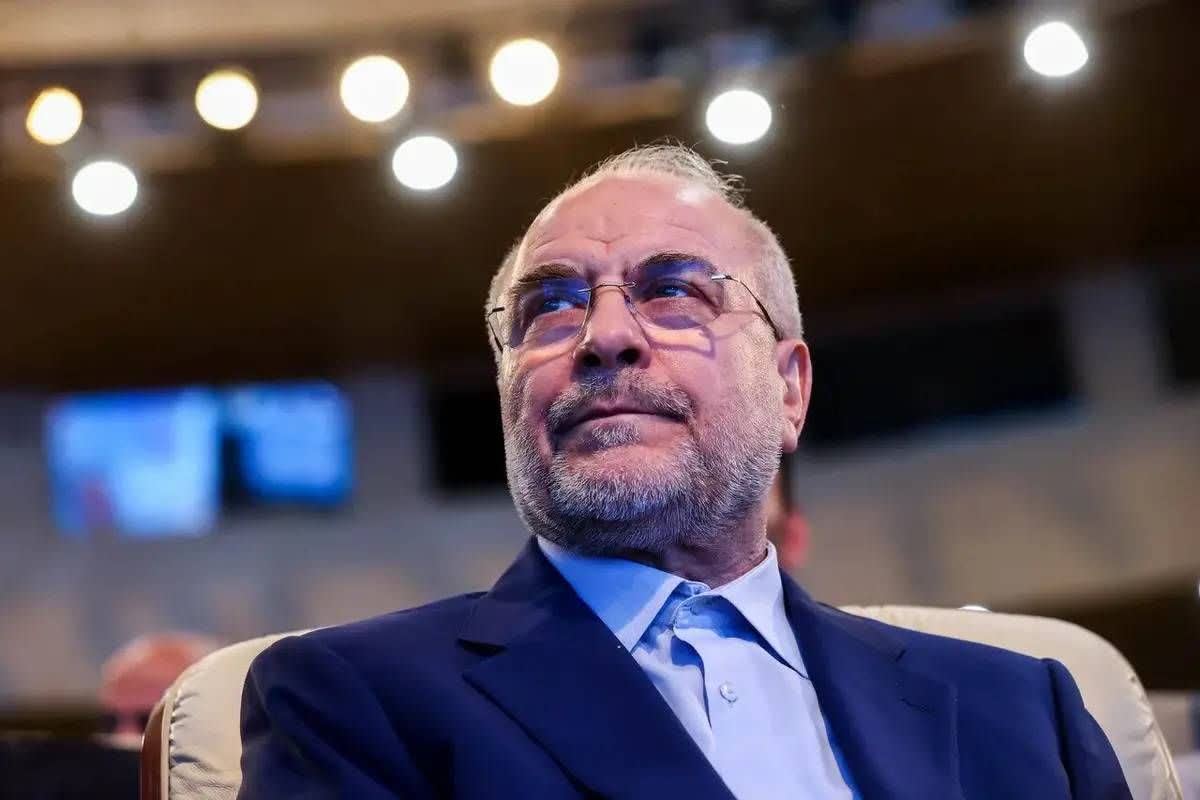
Iranian Parliament Speaker Mohammad Bagher Ghalibaf stated that the U.S. and Israel suffered a strategic defeat in the war with Tehran since both regimes did not achieve their stated objectives.
Tehran – IranView24
“We fought an asymmetric war in such a way that we pushed back the enemy,” he said in a television interview aired on Saturday night.
According to the top lawmaker and lead negotiator, the enemy’s shortcomings were not in resources but in strategy.
“The enemy had money and resources, but they did not act correctly in terms of design,” Ghalibaf stated, adding, “They make strategic errors. They miscalculate regarding our people, just as they miscalculate in their own military design.”
“We are not stronger than the United States in military power,” he said. “It is clear that they have more money, equipment, and resources, and because they have committed so much assault around the world, their experience is also greater than ours.”
He, however, emphasized that material advantages do not guarantee victory.
“Certainly, equipment, resources, and money are effective in war and victory, but it is not always the case,” Ghalibaf noted.
He attributed Iran’s success to strategic ingenuity, saying, “We fought an asymmetric war in such a way that we pushed back the enemy through our own planning and preparation.”
“The enemy had money and resources, but they did not act correctly in terms of design,” the top parliamentarian added.
He also slammed the Trump administration for putting ‘Israel First’ before ‘America First’.
“The US government claims that ‘America First’ matters to it, but in practice, it has shown that Israel comes first for it, because it makes decisions based on Israel’s false information,” the speaker continued.
He asserted that Iran accepted the ceasefire because the US accepted its demands.
“Consolidating the rights of the nation must be our main goal. And rest assured, there will be no capitulation in the field of diplomacy,” Ghalibaf said.
He added that when the enemy could not impose its demands on the Iranian nation through military power, could not influence us with its ultimatums, and saw that the Iranian armed forces were standing firm on the battlefield, it sent messages through various countries.
“Of course, today we are standing even firmer than the day before the ceasefire was established,” Ghalibaf continued.
He said Iran remains firmly positioned on the battlefield and stands ready to respond the moment the enemy makes any mistake, emphasizing that the armed forces are fully prepared even as diplomatic negotiations continue.
He outlined Iran’s dual-track approach of military readiness and diplomatic engagement.
“As long as we pursued matters on the battlefield and militarily, we stood firm, and today we stand firm as well,” Ghalibaf continued, adding, “The moment the enemy makes a mistake, we are ready.
“The parliament speaker and lead negotiator stressed that Tehran has no trust in its adversaries, warning that Iran’s response will be swift to any act of enemy aggression.
“Because we have no trust in the enemy,” Ghalibaf stated, noting, “Even at this very moment, as we sit here, war could break out. The armed forces are fully prepared on the ground.”
He dismissed any suggestion that ongoing negotiations might lead to complacency regarding the matters of national defense.
“It is not the case that we think just because we are negotiating, the armed forces are not ready,” he said, adding, “Rather, just as the people are in the streets, our armed forces are also ready.”
Ghalibaf emphasized that for him, there is no difference between the battlefield and the negotiation table, and he is ready to give his life “to secure the rights of the people.”
Iran’s parliament speaker said he personally warned a US delegation in Islamabad against escalation in the Strait of Hormuz.
Ghalibaf added he warned the US delegation that had come to the Pakistani capital for ceasefire talks that Iranian forces would open fire at minesweepers if they moved “an inch” from their position in the strategic waterway.
The senior lawmaker and lead negotiator laid out a detailed account of the confrontation between the Iranian naval troops and the US military in the Strait of Hormuz, asserting that the Islamic Republic has full control over the vital waterway and has already pushed the United States into a retreat.
“I told the American delegation that if their minesweeper moved even a fraction from its position, we would definitely fire at it,” he said, adding that the US delegation asked for 15 minutes to relay the order to turn back.
Ghalibaf added that the Islamic Revolutionary Guard Corps (IRGC) Navy decisively foiled an attempt to conduct minesweeping operations, which violated the ceasefire.
“We advanced to the point of confrontation, but the enemy retreated,” he noted.
Iran’s parliament speaker, who led Tehran’s delegation for talks with the US delegation in Islamabad last week, said the Strait of Hormuz is under the control of the Islamic Republic.
He also dismissed the Trump administration’s recent move of a “naval blockade” in the Strait of Hormuz as “a clumsy decision born of ignorance.”
Ghalibaf issued a warning regarding global energy transit through the strait, a chokepoint through which about 20% of the world’s oil passes.
“It is impossible for others to pass through the Strait of Hormuz but not us. If the US does not abandon the blockade, traffic in the Strait of Hormuz will certainly be restricted,” he continued, adding, “If any traffic is taking place in the strait today, control of the strait is in our hands.”