
Amid escalating military tensions in the Persian Gulf, the ninth wave of exchanges of fire between the United States and the Islamic Republic of Iran reached its peak in the early hours of Monday, July 20, 2026 (Tir 29, 1405). This conflict, initiated by aggressive US strikes and met with retaliatory Iranian responses, is centered—according to Washington’s claims—on control over the Strait of Hormuz, while Iran perceives it as a continuation of the two US-Israeli imposed wars of June 2025 and February 2026.
Tehran-IranView24
In the latest strikes, US aggressor forces targeted sites on Qeshm Island and southern cities including Shadegan, Sirik, and Hajjiabad. These attacks intensified following the deaths of three US military personnel in the two days leading up to Sunday—two in Jordan and another in northern Iraq.
In response to the aggressive US strikes, the Islamic Revolutionary Guard Corps (IRGC) has launched successive waves of Operation “Nasr-2” against US military targets across the region. IRGC statements No. 30 through 33 regarding Operation Nasr-2 indicate a strategic shift from point-defense to expansive cross-border operations.
Statement No. 30: Destruction of Oil Tankers in the Strait of Hormuz
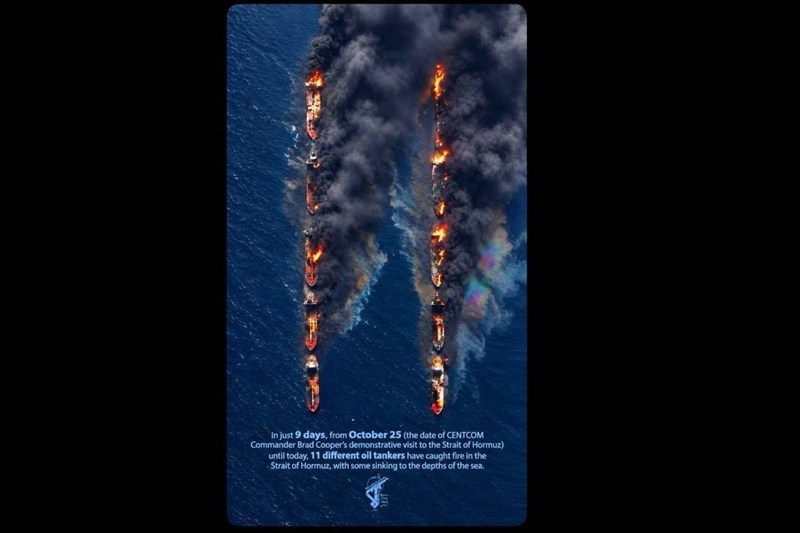
In the first statement, the IRGC announced that late last night, two violating oil tankers—which, under “instigation and coercion by the child-killing US military,” had intended to transit through the unsafe and hazardous route south of the Strait of Hormuz—were exploded and brought to a halt. The IRGC issued a stern warning: “As long as US hostilities continue in the region, this waterway will be insecure for the passage of even a single drop of oil and gas.” This action aligns with the IRGC’s prior threat to halt oil and gas exports from the region should US strikes persist.
Statement No. 31: Appreciation for Jordanian Public Intelligence and Attack on Aqaba Airport
In its subsequent statement, the IRGC expressed gratitude for the “sincere cooperation and precise intelligence provided by the people of Jordan,” which, according to the statement, enabled precise targeting and the complete destruction of 20 warehouses housing US forces in the Al-Azraq region, resulting in the deaths of dozens of US personnel. The statement also reported that IRGC Aerospace Force fighters, in “Wave 21 of Operation Nasr-2,” targeted C-17 heavy transport aircraft and P-8 command and control aircraft of the US military at Aqaba Airport with ballistic missiles, inflicting significant damage on several of them. In this statement, the IRGC declared US military personnel as “Mahdour al-Dam” (whose blood is deemed forfeit under Islamic law) and called upon Muslims to eliminate them wherever they may be found.
Statement No. 32: Attack on Ali Al-Salem Base in Kuwait
The most significant IRGC statement was issued addressed to the “generous people of Kuwait,” announcing that in “Wave 22 of Operation Nasr-2,” an American early warning radar system was completely destroyed, and a warehouse containing aerial equipment and parts, as well as a hangar housing US MQ-9 drones at the Ali Al-Salem base, were struck, with several drones set ablaze. In this statement, the IRGC referenced the long-standing occupation of parts of Kuwaiti territory by US forces and their use as a base for “killing Muslims” in Iran, Iraq, Afghanistan, and Palestine, urging the people of Kuwait to fulfill their “divine duty” and prevent their land from serving as a “source of sedition and the killing of Muslims.”
Statement No. 33: Destruction of US Drone and Special Operations Warehouses in IRGC Triple Strikes
In Statement No. 33, the IRGC reported that the IRGC Naval Force, in Wave 23 of Operation Nasr-2 under the blessed codename “Ya Roghayya (S),” conducted simultaneous three-phase strikes against US targets across the region. In the first phase, warehouses housing US drone maintenance and repair facilities at Al-Sakhir Airport in Bahrain were destroyed. In the second phase, warehouses used for preparing TF-59 vessels at Salman Port in Bahrain were demolished, inflicting severe damage on the vessels. In the third phase, warehouses supporting and equipping US naval special operations forces at the Arifjan base in Kuwait were entirely set ablaze and completely destroyed.
The IRGC has emphasized that these strikes continue in response to US aggression, and in reaction to the US President’s claims regarding the depletion of Iran’s missiles, it has declared that until the end of the war—even if prolonged—missiles and drones will continue to rain down upon US forces.