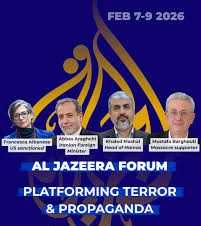
Iran’s Foreign Minister emphasized: “If the world desires peace, it must stop rewarding aggression. If the world seeks stability, it must end support for expansionism; and if the world believes in international law, it must implement it uniformly and without double standards.”
Tehran – IranView24
Seyyed Abbas Araghchi, addressing the 17th Al Jazeera Forum in Doha, stated: “Today, the Israeli regime openly violates borders, tramples upon the sovereignty of nations, assassinates officials, conducts terrorist operations, and expands its influence across various fronts. It does all this not in secret, but with a sense of impunity and entitlement, having learned that there will be no international accountability.”
He added: “The human cost of Israeli crimes in Gaza has wounded the conscience of humanity. These tragedies have torn through the heart of the Islamic world while simultaneously shaking millions of others—from Christians and Jews to followers of all faiths—who still believe that a child’s life is not a bargaining chip, hunger is not a weapon, a hospital is not a battlefield, and the slaughter of families is not legitimate defense.”
Full Text of the Foreign Minister’s Speech Is As Follows:
Excellencies, Distinguished Colleagues, Ladies and Gentlemen, As-salamu Alaykum.
It is an honor to address this distinguished forum on the most fundamental issue of our region: Palestine. Allow me to begin with a truth our region has learned through decades of painful experience, and which the world is once again realizing at a catastrophic human cost: “Palestine is not just one issue among many.”
Palestine is the central issue of justice in West Asia and beyond. It is the strategic and moral compass of our region. It is a litmus test for whether international law still holds meaning, whether human rights are truly universal, and whether international institutions were created to protect the weak or merely to justify the power of the mighty.
For generations, the Palestinian crisis was primarily recognized as a consequence of illegal occupation and the denial of an inalienable right: the right to self-determination. But today, we must acknowledge that this crisis has moved far beyond the concept of occupation. What we are witnessing in Gaza is not merely a war. It is not a “conflict” between two equal sides. Nor is it an unintended consequence of security measures. What is occurring is the deliberate and mass destruction of civilian life. This is genocide.
Today, Palestine is not just a tragedy; it is a mirror held up to the world—a mirror reflecting not only the suffering of Palestinians but also the moral failure of those who had the power to stop this catastrophe but instead justified, enabled, or normalized it.
However, Palestine and Gaza are not merely humanitarian crises. This situation has become the bedrock for a larger, more dangerous project: an expansionist project pursued under the banner of “security.” This project carries three profound and alarming consequences:
The first consequence is global. The Israeli regime’s conduct in Palestine and the impunity granted to it have severely undermined the international legal order. We must state this fact clearly: the world is moving toward a state where international law no longer governs relations between states. Most dangerously, a precedent is being set: that if a state possesses sufficient political cover and support, it can bomb civilians, besiege populations, target infrastructure, assassinate individuals across borders, and still claim legal legitimacy.
The second consequence is regional. Israel’s expansionist project has a direct and destabilizing impact on the security of all regional countries. If the issue of Gaza is “settled” through destruction and forced displacement—if this becomes the blueprint—the West Bank will be the next target. Annexation will become official policy. This is the essence of what has been referred to for years as the “Greater Israel” project.
The third consequence is structural. The expansionist project requires the weakening of surrounding countries—militarily, technologically, economically, and socially—to ensure the regime maintains strategic superiority. Within this framework, Israel is free to expand its military arsenal without limitation, including weapons of mass destruction that remain outside any inspection regime. In contrast, other countries are asked to disarm or are punished for scientific progress. This is not arms control; it is the Doctrine of Dominance.
Ladies and Gentlemen, Expressions of concern, issuing statements, and mourning are not enough. We need a coordinated strategy for action—legal, diplomatic, economic, and security-based—grounded in international law and collective responsibility.
International Legal Support: The international community must unequivocally support legal mechanisms.
Tangible Consequences: Violations must carry real consequences. We call for comprehensive and targeted sanctions against Israel, including:
An immediate arms embargo.
Suspension of military and intelligence cooperation.
Restrictions on responsible officials.
A ban on trade exchanges.
A Credible Political Horizon: Based on the end of occupation, the right of return, and the establishment of an independent, unified Palestinian state with Al-Quds Al-Sharif as its capital.
Collective Responsibility: Regional countries must act in coordination to protect sovereignty and deter aggression. Security cannot be built upon the insecurity of others.
Finally, the Islamic world, the Arab world, and the Global South must form a united diplomatic front. The OIC, the Arab League, and other regional bodies must move beyond symbolism toward coordinated action.
Distinguished Colleagues, No one should miscalculate: a region where one actor is permitted to operate above the law will never remain stable. The doctrine of impunity does not bring peace; it breeds broader conflict.
The path to stability is clear: justice for Palestine, accountability for crimes, an end to occupation and apartheid, and a regional order based on sovereignty, equality, and cooperation.
If the world desires peace, it must stop rewarding aggression. If nations of this region want a future free of endless wars, they must accept this fundamental truth: Palestine is not merely a subject for solidarity; it is the inescapable cornerstone of regional security.