
Do differences of opinion within Iran signal strategic hesitation, or are they a natural part of the decision-making process? Why do Israel and hostile media portray Iran’s internal debates as evidence of a strategic crisis?
Tehran-IranView24
A systematic review of the media and analytical output of international currents hostile to the Islamic Republic of Iran shows that, in recent trends, factional disputes in foreign policy—especially regarding the nuclear file—are no longer interpreted merely as conventional intra-systemic differences of perspective among power actors. Instead, these differences have been redefined within a security-oriented narrative that presents them as signs of the success of Israeli and Western pressure and as indicators of a weakening of the Islamic Republic’s strategic cohesion.
Within this narrative framework, political competition and divergent viewpoints inside Iran are portrayed not as a natural part of elite dynamics and decision-making processes, but as evidence of a structural crisis in governance, the fragility of foreign policy discourse, and the system’s inability to generate strategic consensus. This representational pattern has become more prominent in the regime’s security-analytical literature, particularly after the recent summer war between Iran and the Zionist regime.
Within this narrative framework, political competition and divergent viewpoints inside Iran are portrayed not as a natural part of elite dynamics and decision-making processes, but as evidence of a structural crisis in governance, the fragility of foreign policy discourse, and the system’s inability to generate strategic consensus. This representational pattern has become more prominent in the regime’s security-analytical literature, particularly after the recent summer war between Iran and the Zionist regime.
The Securitization of Diverse Elite Perspectives
A recent report by Raz Zimmt, a senior researcher at Israel’s Institute for National Security Studies (INSS), on the consequences of the summer 1404 war (June 2025), is a salient example of the analytical–narrative exploitation of Iran’s internal developments. The report depicts a politically and strategically incoherent picture of decision-making in the Islamic Republic of Iran and highlights two key components: first, an elite-level rift over whether a strategic paradigm shift is necessary; and second, the decisive role of political leadership in containing or suspending any fundamental transformation in macro-level policies.
Suspension Between the “Threat-Oriented” and “Opportunity-Oriented” Paradigms
The first axis of the INSS analysis emphasizes divergent views among Iran’s political and intellectual elites regarding the country’s future trajectory after the war. In this narrative, a segment of Iranian elites views the recent war as evidence of the erosion of the effectiveness of a “threat-oriented paradigm” in foreign and national security policy and calls for a redefinition of national strategy.
Drawing selectively on statements by certain officials and former figures of the Islamic Republic—citing interviews in domestic and international media—the report underscores the existence of a current that deems a transition from hard, confrontation-based deterrence toward an “empowering opportunities” paradigm as necessary. From this perspective, de-escalation, redefining engagement with the international system, and activating economic and diplomatic capacities are seen as prerequisites for reducing the country’s structural vulnerabilities.
At the same time, the report also refers to the views of conservative and security-oriented currents that interpret the recent war not as a sign of the failure of the existing strategy, but as justification for the continuation of current policies—whether in the nuclear domain or in support for the Axis of Resistance. From this standpoint, any strategic retreat or paradigm shift would send signals of weakness and undermine Iran’s deterrence foundations.
The Institute for National Security Studies assesses this duality as evidence of an “unresolved paradigmatic struggle” within Iran’s power structure—a struggle that could determine the future direction of the country’s security policy but has not yet reached a final decision point.
Drawing selectively on statements by certain officials and former figures of the Islamic Republic—citing interviews in domestic and international media—the report underscores the existence of a current that deems a transition from hard, confrontation-based deterrence toward an “empowering opportunities” paradigm as necessary. From this perspective, de-escalation, redefining engagement with the international system, and activating economic and diplomatic capacities are seen as prerequisites for reducing the country’s structural vulnerabilities.
At the same time, the report also refers to the views of conservative and security-oriented currents that interpret the recent war not as a sign of the failure of the existing strategy, but as justification for the continuation of current policies—whether in the nuclear domain or in support for the Axis of Resistance. From this standpoint, any strategic retreat or paradigm shift would send signals of weakness and undermine Iran’s deterrence foundations.
The Institute for National Security Studies assesses this duality as evidence of an “unresolved paradigmatic struggle” within Iran’s power structure—a struggle that could determine the future direction of the country’s security policy but has not yet reached a final decision point.
The Report’s Policy Recommendation to Tel Aviv
At the same time, this analysis distinguishes between “elite discourse” and “strategic decision-making,” emphasizing that the two do not necessarily move in tandem. According to Zimmt, even if elite-lev
el debates about changing approaches expand, deep strategic reforms—especially in areas such as the nuclear program, relations with the United States and Israel, and regional policy—are not feasible under current conditions.
From this Israeli analytical perspective, the Islamic Republic of Iran is in a state of “suspended transition”: on the one hand, external pressures and the consequences of war have underscored the need for reconsideration; on the other, ideological and structural constraints—particularly the central role of political leadership—have prevented the realization of fundamental changes in overarching strategies. Accordingly, the report concludes that as long as the current leadership structure remains in place, no major shifts in the Islamic Republic’s core policies should be expected.
From this Israeli analytical perspective, the Islamic Republic of Iran is in a state of “suspended transition”: on the one hand, external pressures and the consequences of war have underscored the need for reconsideration; on the other, ideological and structural constraints—particularly the central role of political leadership—have prevented the realization of fundamental changes in overarching strategies. Accordingly, the report concludes that as long as the current leadership structure remains in place, no major shifts in the Islamic Republic’s core policies should be expected.
Linking Political Disputes to Economic and Social Crises in Hostile Narratives
This analytical line is not confined to the INSS report and has been echoed in recent months by a significant portion of Western and hostile media. These narratives rest on several central components that collectively aim to convey the proposition that “Iran’s political system is facing internal divergence and is on the verge of redefining the balance of power.”
Within this framework, political and factional disputes are systematically linked to indicators of economic crisis and signs of erosion in social trust. Verbal disagreements and political rivalries are portrayed not as tactical intra-systemic actions, but as direct reflections of economic and managerial inefficiency.
In these narratives, examples such as rising exchange rates and gold prices, speculation about the impeachment of ministers or potential changes in the cabinet, and even the president’s remarks about referring issues to experts are framed under the label of “signs of economic management collapse.” Policies such as energy price reforms are likewise highlighted as “potential triggers of social protests,” thereby implying a connection between economic dissatisfaction and political disobedience.
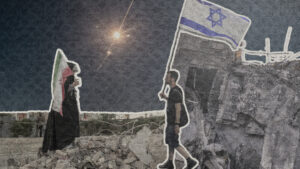 Although this constructed image may not appear significant to some observers, from a visual and media-analysis perspective it merits interpretation. In the image, a woman wearing a chador holds Iran’s half-raised flag, while a man in casual attire (shorts) carries Israel’s fully raised flag.
Within this framework, political and factional disputes are systematically linked to indicators of economic crisis and signs of erosion in social trust. Verbal disagreements and political rivalries are portrayed not as tactical intra-systemic actions, but as direct reflections of economic and managerial inefficiency.
In these narratives, examples such as rising exchange rates and gold prices, speculation about the impeachment of ministers or potential changes in the cabinet, and even the president’s remarks about referring issues to experts are framed under the label of “signs of economic management collapse.” Policies such as energy price reforms are likewise highlighted as “potential triggers of social protests,” thereby implying a connection between economic dissatisfaction and political disobedience.
Although this constructed image may not appear significant to some observers, from a visual and media-analysis perspective it merits interpretation. In the image, a woman wearing a chador holds Iran’s half-raised flag, while a man in casual attire (shorts) carries Israel’s fully raised flag. Beyond creating a symbolic contrast between the two sides, this visual choice conveys several implicit messages:
1-Identity and cultural symbolism: Iranian women’s dress as a marker of national and religious identity, contrasted with the Israeli male figure in casual clothing, may suggest an analytical framing of the two societies.
2-Depiction of power relations and confrontational outlook: Iran’s half-raised flag, compared with Israel’s fully raised one, may subconsciously convey a sense of “relative weakness or fragility” vis-à-vis the opposing power.
3-Media visual language: The choice of gender and attire of the flag bearers is a common tool in news and analytical graphics to highlight political and social messages and to convey strategic and confrontational concepts without lengthy text.
In fact, even the image’s outward details—the type of clothing, the gender of the flag bearer, and the degree to which the flag is raised—can play a role in shaping media narratives and influencing the audience through cognitive-strategic impact.
1-Identity and cultural symbolism: Iranian women’s dress as a marker of national and religious identity, contrasted with the Israeli male figure in casual clothing, may suggest an analytical framing of the two societies.
2-Depiction of power relations and confrontational outlook: Iran’s half-raised flag, compared with Israel’s fully raised one, may subconsciously convey a sense of “relative weakness or fragility” vis-à-vis the opposing power.
3-Media visual language: The choice of gender and attire of the flag bearers is a common tool in news and analytical graphics to highlight political and social messages and to convey strategic and confrontational concepts without lengthy text.
In fact, even the image’s outward details—the type of clothing, the gender of the flag bearer, and the degree to which the flag is raised—can play a role in shaping media narratives and influencing the audience through cognitive-strategic impact.
Strategic Summary
The overall assessment of media and analytical reviews indicates that the narrative construction employed by external and hostile currents regarding Iran’s political developments is based on repetitive, targeted frames aligned with a strategy aimed at undermining the legitimacy of governance. In this pattern, three variables are highlighted simultaneously and in an interconnected manner:
1_ The effectiveness of external pressure in the form of economic sanctions, financial restrictions, and diplomatic isolation;
1_ The effectiveness of external pressure in the form of economic sanctions, financial restrictions, and diplomatic isolation;
2_ Domestic economic crisis manifested through chronic inflation, rising living costs, and erosion of social capital;
3_ Internal power competition among factions and institutions, portrayed as evidence of the fragility of the power structure.
Within such a framework, factional disputes are no longer seen merely as political disagreements, but are transformed into narrative tools for projecting a structural crisis in decision-making cohesion and the effectiveness of the Islamic Republic of Iran’s political system.
Strategic Conclusion of Iran View 24’s Editor
The organized effort by hostile media to link internal political competition to the consequences of the recent imposed summer war, and to connect these developments with economic and social indicators, constitutes part of a deliberate cognitive warfare strategy. Within this framework, the primary focus is on eroding social capital, weakening public trust in the effectiveness of governance, and reframing the enemy’s strategic failures as endogenous crises. In this narrative, discursive differences and intra-elite competition are portrayed not as natural components of domestic political dynamics, but as signs of structural dysfunction in the Islamic Republic’s decision-making system.
This is despite the fact that the Islamic Republic of Iran’s historical experience in simultaneously confronting multilayered external pressures, structural economic constraints, and direct and indirect security threats demonstrates that the country’s macro-level decision-making mechanisms possess the necessary capacity to manage overlapping crises. At strategic junctures, the logic of national security and the requirements of maintaining deterrence have consistently prevailed over factional considerations, tactical disagreements, and short-term political conflicts, thereby determining the course of decision-making.
Ultimately, the strategic conclusion drawn from the recent analysis by Israel’s Institute for National Security Studies is that while Iran’s adversaries mistakenly equate diversity of viewpoints, elite debates, and even candid intra-system criticism with strategic rupture or readiness for fundamental retreat, the field and institutional realities point to the continuation of the Islamic Republic of Iran’s strategy of “smart resilience.” This strategy—despite changes in tools and tactics—has not fractured at the level of overarching objectives and deterrence components. It is precisely this continuity that remains the primary source of concern and dissatisfaction among Western and Zionist circles.
This is despite the fact that the Islamic Republic of Iran’s historical experience in simultaneously confronting multilayered external pressures, structural economic constraints, and direct and indirect security threats demonstrates that the country’s macro-level decision-making mechanisms possess the necessary capacity to manage overlapping crises. At strategic junctures, the logic of national security and the requirements of maintaining deterrence have consistently prevailed over factional considerations, tactical disagreements, and short-term political conflicts, thereby determining the course of decision-making.
Ultimately, the strategic conclusion drawn from the recent analysis by Israel’s Institute for National Security Studies is that while Iran’s adversaries mistakenly equate diversity of viewpoints, elite debates, and even candid intra-system criticism with strategic rupture or readiness for fundamental retreat, the field and institutional realities point to the continuation of the Islamic Republic of Iran’s strategy of “smart resilience.” This strategy—despite changes in tools and tactics—has not fractured at the level of overarching objectives and deterrence components. It is precisely this continuity that remains the primary source of concern and dissatisfaction among Western and Zionist circles.