The Eastern Mediterranean has once again become a focal point of geopolitical competition—a place where a trilateral agreement among the Zionist regime, Greece, and Cyprus may go beyond a mere military pact and send a clear message signaling the beginning of Turkey’s gradual strangulation on its western flank.
Ali Heidari – Expert on Turkish Affairs
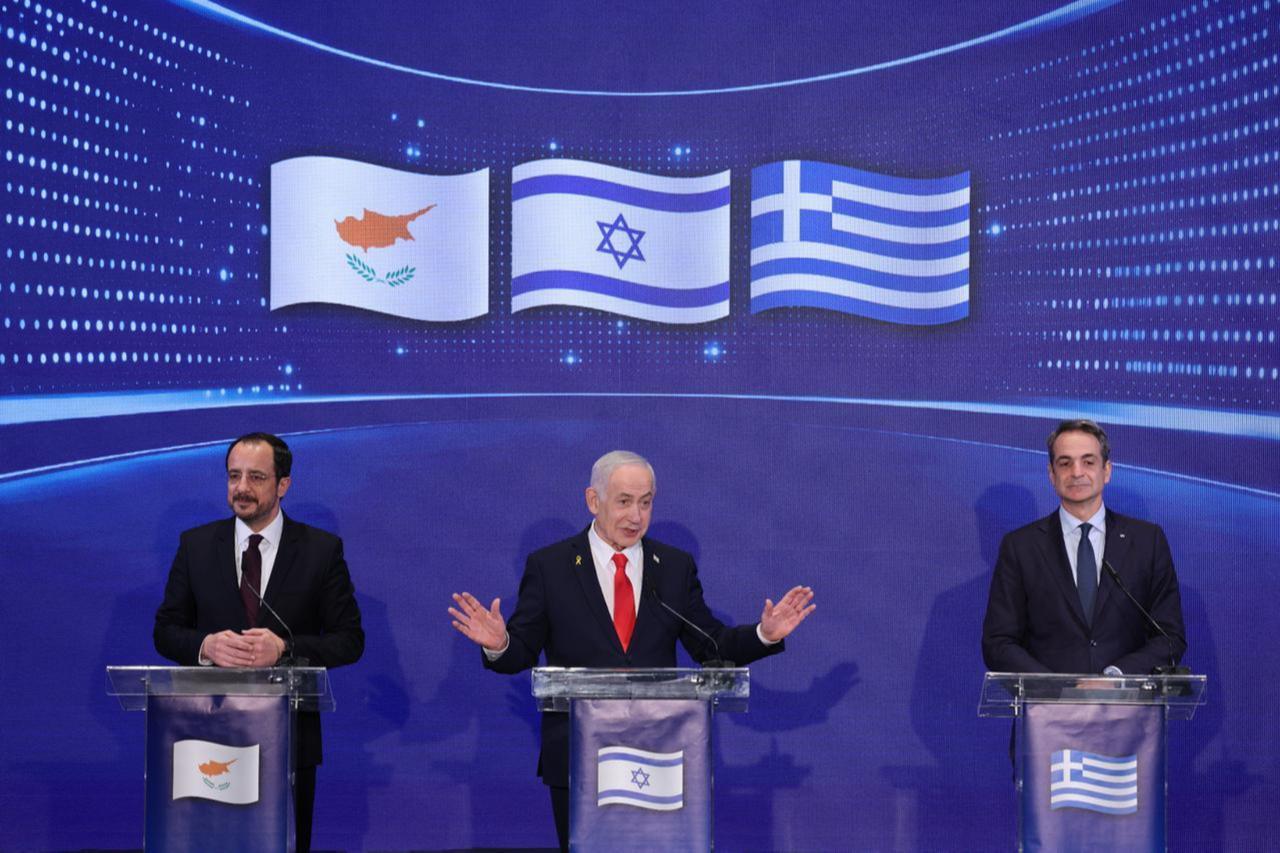
Last week, a regional security pact was signed in Jerusalem, under which the Zionist regime, Cyprus, and Greece decided to form a 2,500-strong rapid reaction force. According to this agreement, an attack on any one of the three parties would be considered an attack on the others, obligating them to intervene and assist the party under attack.
But why was this pact formed?
In his statement after signing the agreement, Benjamin Netanyahu addressed Turkey and Erdoğan, saying: “To those who fantasize about building empires and dominating our state, I say: forget it. It will not happen. Don’t even think about it.” Beyond this explicit warning, another common feature among the three parties can be found in their longstanding rivalry or hostility toward Turkey.
Greece, which was expelled from Turkish territory after its defeat in the Turkish War of Independence in 1923, managed—thanks to the Treaties of Sèvres and Lausanne—to assert control over vast areas of Turkey’s maritime sovereignty by acquiring islands close to the Turkish mainland. This development has constrained Turkey’s access in the Aegean and the Eastern Mediterranean, periodically reigniting tensions and even hostilities between the two sides.
The Republic of Cyprus, due to the occupation of its northern part by Turkish military forces in 1974 and the establishment of an autonomous republic there with Ankara’s full support—a situation that has continued to this day—has experienced a kind of hostility in its relations with Turkey over the past 50 years and has missed no opportunity to strike at Turkish interests.
The Zionist regime during the Netanyahu era—especially after the attack on Gaza and Turkey’s stance on it—has likewise sought to undermine Ankara’s interests, pursuing this objective in Syria, Gaza, Lebanon, and now even in the Eastern Mediterranean.
Why the Mediterranean?
The Mediterranean Sea—particularly its eastern basin—is of great importance both economically and geographically:
Energy Resources:
The Mediterranean is one of the region’s vast energy reservoirs, and all neighboring countries are striving to secure a larger share. This issue becomes even more significant when we consider that after the Ukraine war, Europe made a strategic shift to reduce and eventually cut its dependence on Russian energy. In this context, Mediterranean energy resources—close to Europe—gain far greater importance.
Geographical Position:
The Mediterranean functions as a joint hinge connecting Europe, North Africa, and the Middle East. Any country or bloc that can establish a presence and dominance there can exert profound influence over the fate of the region. The importance of this area is such that even Russia, from thousands of kilometers away, has established military bases there, while the United States maintains a presence with the help of Cyprus and Greece, as well as its aircraft carriers.
Economic Value:
Tourism and the Mediterranean’s marine resources are among the other advantages this sea offers its neighbors—benefits that cannot be overlooked.
The Importance of the Mediterranean for Turkey
Since the Ottoman era, Turkey has attached great importance to this sea. A large portion of Ottoman expansionist operations were conducted via the Mediterranean, and aside from Spain, Italy, and France, vast areas of the Mediterranean were regarded as an internal Ottoman sea.
In the current era as well, due to its energy resources and the economic and political advantages they provide Ankara, Turkey has invested heavily in this region.
If Turkey gains access to the region’s energy resources, it could not only meet its own needs—estimated at more than $100 billion annually—but also partially supply Europe’s demand. This, in turn, would have a profound impact on increasing Turkey’s political standing in Europe.
The importance of this region is such that Ahmet Davutoğlu, former prime minister of Turkey, has stated that Turkey is an Eastern Mediterranean country and must carefully pursue a strategy to secure its interests there. If Turkey is hemmed in by Greek and Cyprus in this region, its gateways to the world will be significantly constrained. Ankara must make maximum use of Northern Cyprus, which serves as an “unsinkable aircraft carrier” in the Eastern Mediterranean. Constraints in the Mediterranean would also limit Turkey’s ability to project influence into Africa.
The points raised by Turkey’s foreign policy theorists over the past two decades show that the Mediterranean is of vital importance to Turkey—and that the Zionist regime has well understood that, to control Turkey at least on its western front, it can act to constrain Ankara with the help of Turkey’s adversaries.
Strategic Isolation and Geopolitical Strangulation
At present, from Turkey’s west to its south, it is surrounded by neighbors with whom it has numerous problems. Looking at the map, aside from Bulgaria—which itself does not enjoy particularly warm relations with Ankara—Greece, the Republic of Cyprus, and the Zionist regime form a crescent from Turkey’s west to its southwest in the Mediterranean, all maintaining tense relations with Turkey. To the south lies Syria, which is under the influence of the Zionist regime and the Syrian Democratic Forces and is in a dire state. Thus, it can be said that Turkey is gradually being drawn into a form of geopolitical encirclement by the Zionist regime and faces difficult conditions ahead.
Conclusion
Following the Gaza war, the Zionist regime—seeking to shape a new regional balance with American management and support—has, after Gaza, Lebanon, Syria, and Iran, turned its attention to Turkey in an effort to constrain this Islamic country as well.
Although the prospect of war between the Zionist regime and Turkey seems unlikely, Tel Aviv is pursuing the creation of coalitions against Turkey to exert comprehensive pressure on Ankara, with the help of its enemies and staunch rivals—including Greece, Cyprus, the UAE, France, and others—to curb Ankara’s ambitions, at least during the Erdoğan era.
For Turkey, the Mediterranean is of vital importance from energy, economic, and political perspectives. Aware of this, Tel Aviv is seeking to shape a military-security belt in the region to obstruct Turkey’s interests there, limit its influence in the West, and curb its penetration into North Africa—moves that will further intensify Turkey’s strategic concerns, especially on its western front.