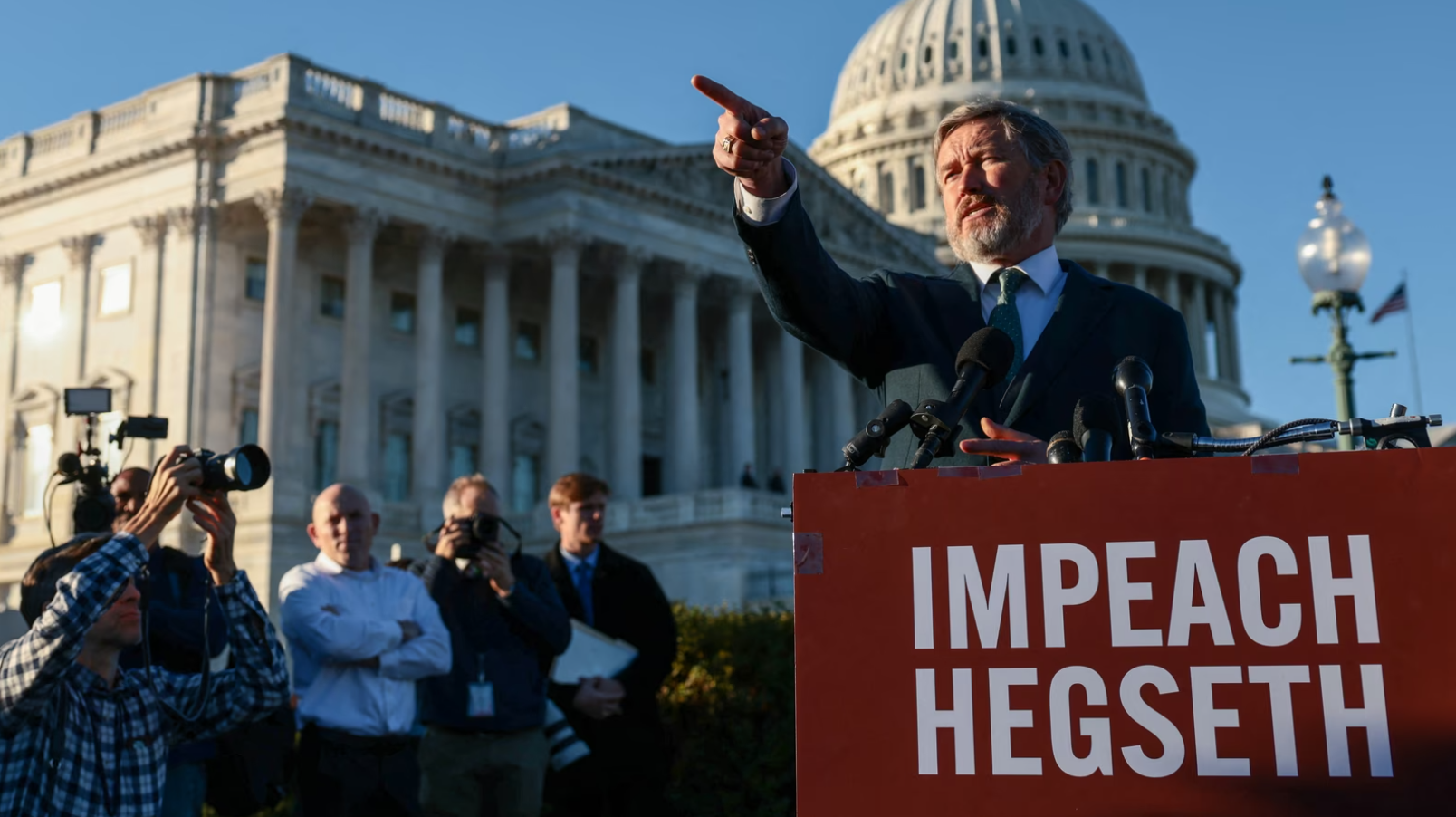
The impeachment effort against Pete Hegseth, Secretary of War in Donald Trump’s administration, failed in the U.S. House of Representatives on Tuesday, November 10. However, details of the vote indicate that this failure was not solely the result of Republican support for the Trump administration. The absence of 11 Democratic representatives, who have a record of receiving campaign contributions through the financial network of the American Israel Public Affairs Committee (AIPAC), has become one of the most controversial aspects of the case.
Iran View 24 – United States
The House of Representatives voted 211 in favor and 204 against referring the impeachment resolution against Hegseth, introduced by Republican Representative Thomas Massie, to the House Judiciary Committee—an action that effectively halted the impeachment proceedings in the current Congress.
Thomas Massie, a Republican representative from Kentucky and the author of the impeachment resolution, was the only Republican to oppose referring the resolution. All 203 Democrats present also voted against the measure. However, 11 Democrats were absent from the vote.
Following this controversial vote, which sparked anger among political activists critical of the move from both the Democratic and Republican camps, a new revelation emerged on the U.S. political scene. Reports published on November 11 indicate that all 11 Democratic members of the U.S. House of Representatives who did not participate in the vote that led to the suspension of the impeachment resolution against Pete Hegseth had received significant financial contributions from AIPAC. This comes as just seven votes would have been enough to change the outcome of the 211–204 vote.
AIPAC’s Financial Footprint Among the Absent Representatives
An examination of the published data shows that the amount of campaign funding received by the absent representatives varied.
– Haley Stevens (Michigan): $15.9 million (the largest recipient of campaign funding in Congress)
– Laura Gillen (New York): $551,000
– Marilyn Strickland (Washington): $371,000
– Steven Horsford (Nevada): $214,000
– Nancy Pelosi (California): $166,000
– Julia Brownley (California): $134,000
– Brittany Pettersen (Colorado): $125,000
– Lou Correa (California): $80,000
– Frederica Wilson (Florida): $39,000
– Melanie Stansbury (New Mexico): $28,000
– Jonathan Jackson (Illinois): $21,000
If the 11 absent Democratic representatives had attended the session and voted against referring the resolution, as their 203 Democratic colleagues in attendance did, then, counting Thomas Massie’s vote, the result would have changed to 215 votes against and 211 votes in favor.
As a result, the motion to refer the resolution to the House Judiciary Committee would have failed, and the parliamentary process for impeachment would have continued.
AIPAC: A Network Extending Beyond Campaign Contributions
AIPAC’s role in U.S. politics is not limited to providing financial support to a number of representatives. In recent years, the organization has become one of the major players in congressional lobbying and electoral competition.
According to independent data, since 2022, 166 Democratic representatives and 247 Republican representatives—a total of 415 members of Congress—have received campaign contributions through the financial network of the American Israel Public Affairs Committee (AIPAC).
This broad reach indicates that AIPAC’s financial influence is not confined to a single party and that the organization works to maintain bipartisan support for U.S.-Israel relations.
AIPAC also makes independent expenditures in electoral contests through its affiliated political entity. This entity operates as a Super PAC and can spend without the usual limits on direct contributions to candidates, provided the spending is for independent campaign advertising.
Why Does Hegseth’s Survival Matter to Supporters of Israeli Policies?
Pete Hegseth is one of the leading figures behind the Trump administration’s security approach toward Iran and West Asia. His military policies and support for close cooperation between Washington and Tel Aviv overlap with some of AIPAC’s strategic priorities.
From this perspective, weakening or removing the Secretary of War could have had consequences extending beyond a change in one cabinet position and could have affected U.S. military policy toward Iran and Israel.