The failure of the United States and Israel in several rounds of airstrikes against Iran has led to the increasing seriousness of the terrorist component in a potential next round of escalation; a pattern that could differ from the terrorist operations of January 2026.
Iran View 24 — Defense and Security
The United States and Israel, at various times, have employed a combination of military pressure, intelligence operations, support for armed or opposition actors, covert operations, sabotage, cyberwarfare, economic pressure, and engagement with local forces to increase pressure on rival governments. This pattern has repeatedly been employed in the case of Iran.
With regard to other countries, there is a long historical record and body of evidence concerning terrorist network-building by the United States, from Latin America to West Asia and even East Asia—from Nicaragua, Chile, Vietnam, and many other countries across the world to Iraq, Afghanistan, and Syria.
Among the most tangible instances of terrorist intervention in the countries of the region are the use by the United States and Israel of terrorist network-building and Kurdish armed capabilities in Iraq and Syria, as well as the Arab-Afghan network-building conducted by the United States in Afghanistan and Pakistan during the 1980s.
Declassified U.S. documents indicate that during the 1980s, the U.S. intelligence agency, the CIA, in cooperation with Pakistan, helped create al-Qaeda and facilitate the rise of the Taliban against the Soviet Union. With regard to Iraq, declassified U.S. State Department documents confirm that Washington began providing covert support to separatist Kurdish forces under the leadership of Mullah Mustafa Barzani in Iraq in the early 1970s, with this support being carried out in coordination with the Shah’s regime in Iran and with the indirect participation of Israel.
A March 1970 U.S. State Department document refers to Idris Barzani’s meeting with Israeli representatives and a proposal to provide weapons to the Kurds. Documents from 1974 also indicate that U.S. financial and military assistance to the Iraqi Kurds was approved. In July 1972, the Nixon administration decided to provide covert support to the Kurds in Iraq. A March 1973 document also refers to the transfer of more than 1,000 tons of equipment and the creation of conditions enabling the maintenance of a force of approximately 25,000 personnel under Barzani’s leadership.
An official document from Foreign Relations of the United States (FRUS), Volume E–4, Document No. 267, is a CIA intelligence cable dated March 9, 1970, held in the U.S. National Archives and published by the U.S. Department of State. The subject of the document is explicitly “Israeli Aid to Kurdish Rebels.” According to the document:
- Idris Barzani arrived in Tehran on March 4, 1970.
- On March 4 and 5, Idris Barzani and two others met with representatives of the Israeli government in Tehran.
- The report states that the Israeli representatives were pressing for the resumption of fighting in northern Iraq.
- According to the same report, the Israelis had promised to provide the Kurds with anti-aircraft weapons and light artillery.
- An agreement had also been reached concerning armored vehicles and personnel carriers.
- The provision of tanks through Iran and the training of Kurdish forces to operate the tanks were subsequently discussed.
- The following day, Idris Barzani met with SAVAK chief Nematollah Nassiri. Nassiri stated that Iran fully supported the Israeli plan to resume the war in northern Iraq.
- The document also reports the amount of Iranian and Israeli financial assistance provided to Barzani during the previous month as 1.2 million Iraqi dinars, equivalent to approximately $3.36 million at the time.
In 1974, U.S. financial and military support increased. In an April 1974 memorandum from Henry Kissinger to Nixon, the objective of the program was described as strengthening the Kurds’ ability to maintain their position and keeping the Iraqi government engaged in conflict. In June 1974, a proposal to allocate $8.06 million for fiscal year 1975 was also put forward and approved.
At this stage, the principal objective of the external actors was to weaken Iraq and contain Soviet and Baghdad influence in the region. In 1975, the Algiers Agreement between Iran and Iraq led to the termination of Iranian support for the Iraqi Kurds, followed by the termination of the U.S. assistance program. CIA documents state that, following the cutoff of Iranian assistance, the Kurdish resistance collapsed.
A CIA document from June 1975 states that, following the termination of Iranian support, the U.S. assistance program also ended and the Kurdish resistance collapsed. This position, together with subsequent historical evidence during the eight-year imposed war and the U.S.-Israeli wars against Iran, demonstrates how consequential the participation—or non-participation—of neighboring countries can be in such terrorist schemes.
Following the Islamic Revolution, the regional security structure underwent major changes. The Iran-Iraq War, the suppression of Iraqi Kurds, the Gulf War, and subsequently the establishment of a no-fly zone in northern Iraq created new conditions for Kurdish groups. This process later contributed to the emergence of an environment in which some Iranian Kurdish separatist groups were also able to establish an organized presence in the Kurdistan Region of Iraq and play an active role in the war against Iran during the eight-year imposed war.
The fall of Saddam Hussein’s government marked a turning point in the geopolitics of the region. The Kurdistan Region of Iraq gained greater autonomy and security, and Iranian Kurdish groups were able to operate in an environment that was less controlled than in previous decades.
Similarly, within the framework of Washington’s anti-Iran strategy, the U.S. Department of State removed the People’s Mojahedin Organization of Iran (MEK) from the Foreign Terrorist Organization list in September 2012, enabling this terrorist organization to increase its role in anti-Iran operations on Iranian territory through its existing capabilities and networks.
U.S. and Israeli terrorist actions against Iran have also included the hiring of domestic thugs and the activation of separatist terrorist groups along Iran’s eastern and western borders.
In June 2025, the Associated Press, based on interviews with Israeli intelligence and military sources, reported on a years-long effort to infiltrate Iran, collect intelligence, use local operatives, and secretly deploy equipment inside Iran.
An obscure media outlet also reported in August 2025, citing interviews with intelligence sources, on the recruitment of Iranian dissidents and their use in operations against Iran’s defense systems.
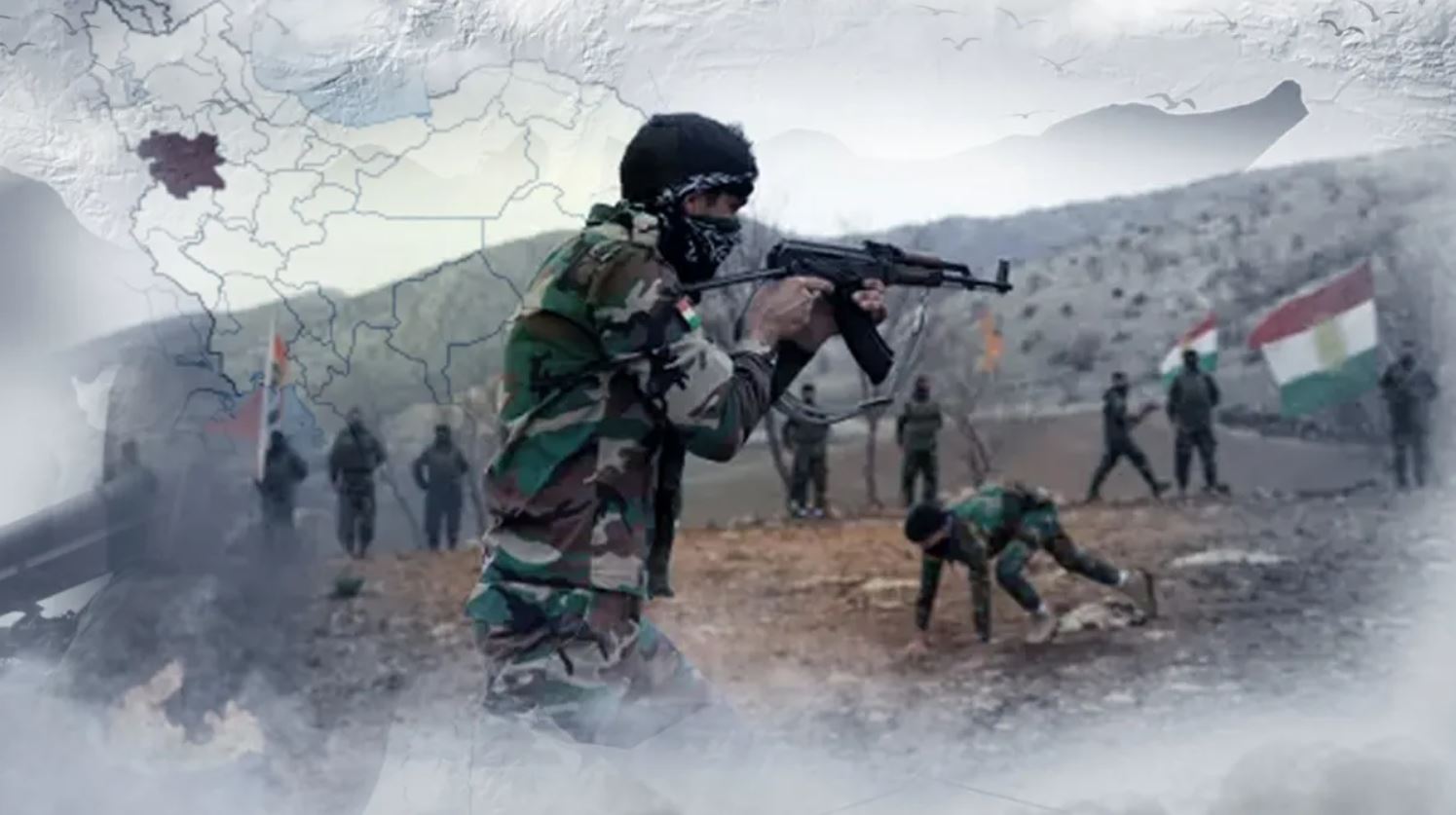
In 2026, following the outbreak of the second U.S.-Israeli war against Iran, the issue of using Iranian Kurdish groups entered a new phase. U.S. President Donald Trump repeatedly announced U.S. material and weapons support for Iranian Kurdish separatist and terrorist groups.
From a purely strategic perspective, the use of local actors can provide a foreign adversary with several advantages:
- Reducing the need for large-scale deployment of its own forces and lowering the cost in terms of its own personnel;
- Increasing pressure on the target government from multiple directions;
- Exploiting the geographic and social knowledge of local actors;
- Providing a degree of political deniability for efforts aimed at political change;
- Increasing pressure simultaneously with external attacks.
Given the historical record, it can be stated with confidence that the use by American-Israeli adversaries of networks of criminals and thugs, separatists, and proxy forces is a recognized instrument of security policy and has a documented history.
Therefore, in assessing the threat against Iran, attention should extend beyond a sole focus on the possibility of airstrikes and instead consider the synergy among air attacks, sabotage operations, cyberwarfare, economic pressure, psychological warfare, and the activation of domestic and cross-border terrorist capabilities.