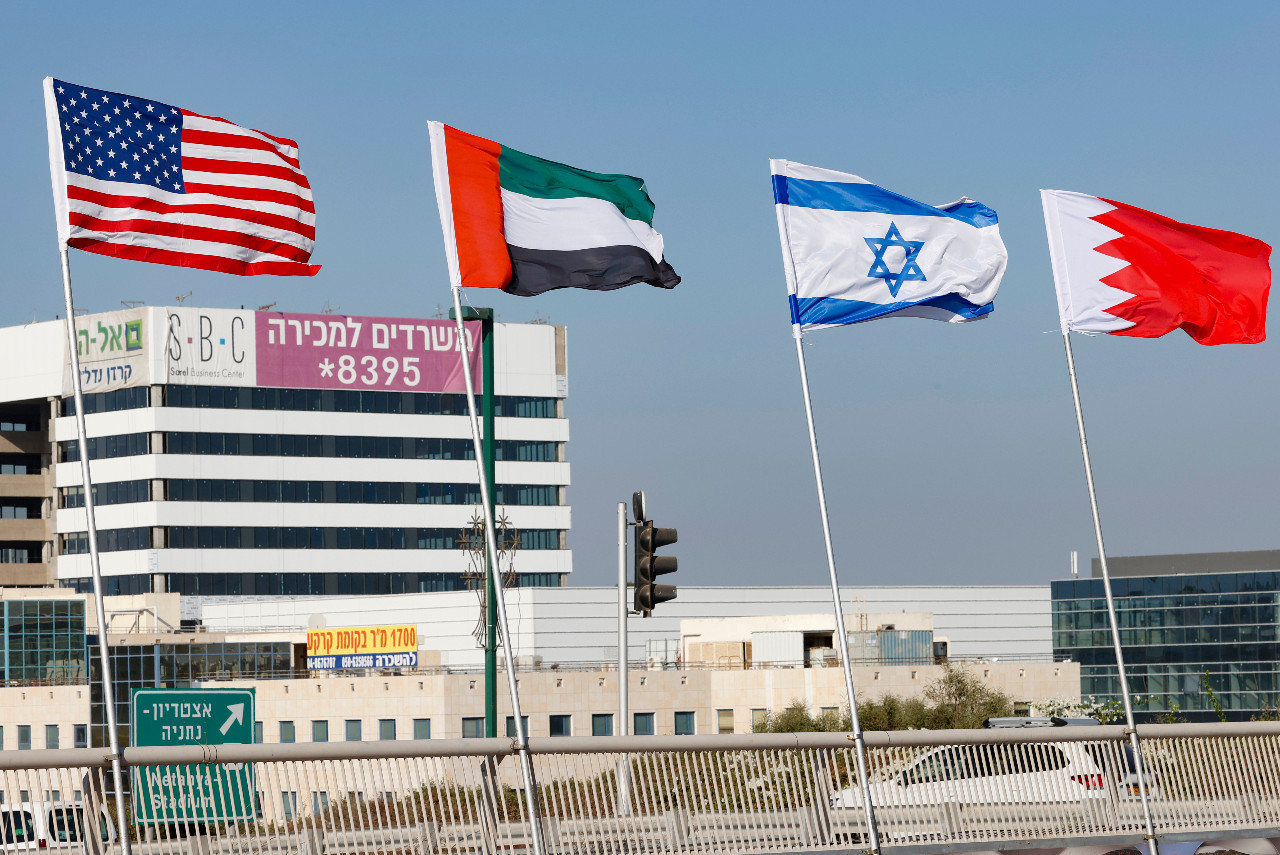
While some Arab countries express concern in their media positions about the escalation of tensions with Iran, at the same time there are signs of their closer cooperation with the United States and Israel against Tehran; from political contacts at the highest levels to security and military relations; from the overt activities of the United Arab Emirates to the hypocritical conduct of Saudi Arabia.
Afifeh Abedi – Foreign Policy Analyst
For nearly five decades, relations between the Islamic Republic of Iran and most of its Arab neighbors, alongside the issue of Palestine, have been one of the enduring geopolitical conflicts of West Asia, characterized by a recurring pattern: Arab concerns over Iran’s power and influence, efforts to contain it, reliance on extra-regional powers, and then a forced return to accepting the existential reality of Iran and the necessity of dialogue with Tehran once the costs of confrontation have increased.
This cycle has been repeated several times since the Islamic Revolution in Iran. However, it appears that the policy of the neighbors, particularly the countries of the Gulf Cooperation Council, has once again returned to the starting point of this cycle, and they still operate on the assumption that Iran’s power can be limited through a combination of external pressure, military alliances, economic pressure, regional containment, and support for Tehran’s rivals.
This note seeks to recall the recurring mistakes in the policies of some Arab governments, particularly the monarchies and emirates of the Persian Gulf, toward Iran and their direct consequences.
1. First mistake: The assumption that the Islamic Republic can be removed from the region through external pressure
The 1979 Iranian Revolution was a geopolitical shock for many Arab governments. The issue was not merely the change of a pro-Western government in Tehran; from the outset, the Islamic Republic carried a revolutionary and anti-status-quo message, and some Persian Gulf governments viewed it as an inspiration for domestic movements and a transformation of the regional order against them.
The Persian Gulf Cooperation Council was formed within the context of these developments. The Iran-Iraq War also created a new security environment in which many Persian Gulf countries believed that Iraq could serve as a barrier against Iran.
The Persian Gulf countries provided Iraq with financial, political, and military support. Kuwait, Saudi Arabia, and other Arab countries provided significant resources to Saddam’s Ba’athist regime. But from a long-term geopolitical perspective, an obvious contradiction emerged. The power that was being built to contain Iran itself became a threat to the Arab countries.
Kuwait, which during the imposed war against Iran had provided billions of dollars in assistance to Saddam’s regime, was attacked by Iraq only two years after the end of the Iran-Iraq war, in 1990.
Meanwhile, the end of the eight-year war in 1988 did not result in Iran’s removal from the regional equation. On the contrary, Iran used the war as a fundamental experience demonstrating the necessity of developing an “independent deterrence.”
This may be one of the most important lessons forgotten by the foreign-policy establishments of Arab countries from the eight-year imposed war against Iran: the ongoing American-Zionist-Arab war could also be repeated in another form, through the strengthening of Israel and the creation of an existential threat to Arab countries.
2. First mistake: Turning geopolitical competition into identity-based and sectarian rivalry
Following the revolution, part of the competition between Iran and some Arab governments was transformed into a conflict articulated through the language of “Arab and Persian,” “Sunni and Shiite,” and “Revolution and Monarchy.” In the short term, this approach could create broad Sunni political mobilization against Iran, but strategically it carried long-term costs. Because it enabled Iran to transform part of the regional competition from a purely inter-state rivalry into an issue concerning the identity and security of Shiite communities. In such an environment, Iran was no longer competing only with Arab governments; transnational social, religious, and political networks also became part of the equation, and the Axis of Resistance emerged.
The ongoing hybrid war against the Axis of Resistance may impose costs on resistance groups, but it creates the conditions for the rise of Islamic movements in the near future.
3. Third mistake: Excessive reliance on the United States
From the 1990s onward, a large part of Persian Gulf security was built around the U.S. military presence. This policy may have placed Arab governments under the American security umbrella, but it also produced an unintended consequence: regional governments, in many cases, relied on the security guarantees of an external power instead of building an indigenous and regional security architecture.
As a result, a paradox emerged: Arab countries moved closer to the United States to confront Iran; Iran, observing this trend, assessed the threat more intensely; and this contributed to the strengthening of Iran’s deterrence and network-based policies.
Ultimately, both sides entered a security cycle and an escalation of threat perceptions in which the defensive action of one side was interpreted by the other side as an indication of threat.
This mistake is also taking place in the ongoing war and could lead to a new form of Iranian deterrence against the American-Zionist-Arab axis.
4. Fourth mistake: The assumption that overthrowing or dismantling resistance groups would automatically eliminate Iran’s influence
Decades of extensive efforts for Arab-Saudi dominance in Iraq, Syria, Lebanon, and Yemen not only failed to produce the intended result, but also increased Iran’s influence. In the example of recent years as well, the Arabs should have understood that the replacement for Iran’s presence is not their own presence, but rather an aggressive Zionist policy, the evidence of which can be seen in Syria and Lebanon. But in the long term, it can be said that even if an ally of Iran is weakened, Iran’s influence will not necessarily disappear; it may simply change its form.
5. Fifth mistake: The assumption that economic pressure will lead to Iran’s surrender
Sanctions and economic pressure have been the principal instruments of the United States and its allies against Iran over the past decades, and Arab governments have also supported them. But a distinction must be made between two objectives: 1. reducing Iran’s resources; 2. changing Iran’s security calculations.
Increased external threats have led to the concentration of resources and greater investment in cheaper and indigenous deterrence tools: missiles, drones, and advances in Iran’s indigenous defense technologies, which in the ongoing war have contributed to the power and decisiveness of Iran’s retaliatory strikes; this is apart from Iran’s indigenous advances in civilian technologies.
6. Sixth mistake: Underestimating direct diplomacy with Tehran
Over the past several decades, whenever relations between Iran and Arab countries have entered a phase of dialogue, the possibility of crisis management has generally increased. An important example was the Iran-Saudi Arabia agreement in March 2023, which, with China’s mediation, restored diplomatic relations between the two countries. In the text of the agreement, both sides emphasized respect for sovereignty, non-interference, and the implementation of previous cooperation agreements.
This experience revealed an important reality: Arab countries do not necessarily have to wait for an agreement between Iran and the United States in order to manage tensions with Iran. Competition can continue without an exclusionary approach. Direct diplomacy can serve as an “independent layer” of regional stability and security.
7. Seventh mistake: The assumption that all Arab governments must unite against Iran
This is one of the structural problems of Arab policy. Developments over the past several decades have demonstrated that, for example, the interests of Oman and Qatar are not the same as those of Saudi Arabia or the United Arab Emirates. Iraq’s position is not the same as that of Qatar, Saudi Arabia, or the United Arab Emirates. Even Saudi Arabia and the United Arab Emirates, despite their close cooperation, have had different priorities on some regional issues. As a result, efforts to create a “unified Arab front against Iran” have in practice led to the strengthening of Islamic movements and resistance movements aligned with Iran.
Overall
During the ongoing war as well, the Persian Gulf countries, by repeating these mistakes, have become directly involved with the security and economic consequences of the war. However, it appears that the policy of the neighbors, particularly the countries of the Persian Gulf Cooperation Council, remains based on the assumption that Iran’s power can be limited through a combination of external pressure, military alliances, economic pressure, regional containment, and support for Tehran’s rivals, without necessarily requiring the establishment of a stable security arrangement agreed upon with Iran in the region.
But developments once again show that any war involving Iran, due to the geography of the Persian Gulf, cannot easily remain a “war far from the Arabs.” Moreover, every round of efforts to contain Iran has resulted in a transformation in the form of Iranian power, rather than its elimination. Historical experiences indicate that the ongoing war could also produce another leap in Iran’s power and deterrence.