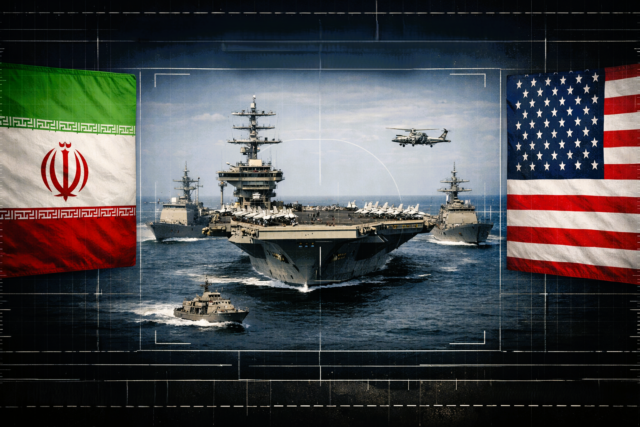
The US Air Force has announced it is gearing up for a multi-day military exercise across the Middle East. The drill is set to kick off in Qatar with the participation of Persian Gulf Cooperation Council (GCC) member states and will run for 11 days. In recent weeks, the US has also significantly beefed up its military presence in the region. This exercise comes amid escalating tensions between the US and Iran, raising the specter of renewed conflict. Should military hostilities erupt, regional countries would inevitably be caught in the crossfire, making the GCC’s involvement a point of considerable interest. Mohsen Farkhani, an international affairs expert, told Iran Daily that the US is unlikely to seek direct conflict with Tehran and that the increased military build-up in the region is a way to pile on psychological pressure and facilitate the re-entry of Israel into conflict with Iran.
Mohsen Farkhani, Iran Daily
IRAN DAILY: How do you assess the US Air Force’s exercise at this juncture? Is this drill merely a military maneuver, or are there other objectives at play?
FARKHANI: The joint exercise between the US and GCC member states, taking place amid rising tensions between Iran and the United States, cannot be simply written off as a routine military exercise between allied nations. The timing itself contradicts such an assessment. According to the US 2025 National Security Strategy, and considering the Trump administration’s return to the Monroe Doctrine (emphasizing a focus on national interests within the Western Hemisphere and distancing itself from past alliances) and the expectation that allies will shoulder the costs of their own security in line with the Nixon Doctrine, this joint exercise is significant in two respects.
Firstly, the US is attempting to pass the buck of security costs onto its allies in the Persian Gulf through arms and logistical support, thereby distancing itself from a full-scale war with Iran due to domestic challenges within the US. Secondly, the United States is unlikely to pursue direct conflict with Iran, and the escalation and increase of US military weaponry in the region is a means of ramping up psychological pressure and facilitating the re-entry of Israel into the continuation of war with Iran and violating the ceasefire [in June]. On this basis, a game is being played, consisting of several simultaneous scenarios.
One: The US is projecting a full-fledged commitment to its allies in the GCC, having already reaped billions of dollars from the leaders of these countries, to support them in times of security crises. However, at the same time, it is waking them up to its disinterest in direct involvement in Middle Eastern wars. The fact that 70 different scenarios will be practiced over the 11-day duration of the exercise suggests an effort to avoid direct involvement and to provide only arms and training support, which aligns with the Nixon Doctrine.
Two: Given the deployment of diverse military weaponry in the region, the likelihood of war is considered highly probable, but seems somewhat far-fetched during the joint exercise.
However, given the current tense conditions, the US disinterest in a full-scale war with Iran, and its desire for Israel to initiate the conflict alone, it is possible that the US would take advantage of this exercise to place GCC member states in a fait accompli and to prevent them from backing out of a collective war with Iran, potentially leading to the commencement of Israeli attacks during the exercise.
What kind of reactions could be expected from Iran in the event of any provocative action?
With US unlikely to initiate military action, should any such move occur from Israel and drag GCC member states into war, the necessity of Iran entering combined military actions against US military bases and equipment in regional countries and Israel would be unavoidable. This would also include cyberattacks and the involvement of Shiite movements aligned with the Islamic Republic of Iran, threatening the economic targets of GCC member states, the US, and Europe in the Persian Gulf.
In your opinion, what is the best way to deter and prevent the escalation of tensions?
Currently, the US is applying diplomatic and psychological pressure on Iran in the most aggressive manner possible. Moreover, the conditions the US has set for diplomatic engagement and de-escalation are essentially a zero-sum game. Therefore, the only way to create deterrence for the US is to convey the sense of incurring a prohibitive cost and engaging in a full-scale war, so that Washington, due to its lack of interest in entering a widespread conflict and the risk to its own national interests and security, will back down from its positions. The use of deterrent language by Iranian officials and actions that reflect Iran’s seriousness in responding to any malice from the US and Israel will both discourage Washington and Tel Aviv to enter a war with Iran and will also cause the GCC member states to calculate correctly about not joining the US game.
How would you characterize the cooperation of the GCC member states in this exercise? Is this cooperation an action to prepare for potential threats?
Given that this exercise is designed to send a multi-layered message to regional actors in the Persian Gulf, GCC member states will not only benefit from US logistical, arms, and training support, but will also see themselves as operational allies of the US, who will not be alone in the event of a crisis and will see the US as an active security partner. Participating in this joint exercise, given their concerns about potential Iranian attacks on US bases in their countries, is a bid to send a message of strong willingness to avoid tensions with Iran and deter Tehran from engaging in retaliatory operations in their territories.